

Table of Contents
- Why Online Tack Stores Beat Local Shops for Everyday Riders
- What to Look for in a Reliable Online Tack Store
- How to Measure for Horse Tack: A Quick Guide
- Saddle Fitting Guide for Online Shoppers: Get It Right the First Time
- Choosing the Right Horse Bridle Sets and Materials
- What About Shipping, Returns, and Customer Support?
- Make the Switch to Online Tack Shopping Today
- Frequently Asked Questions
Last Updated: September 6, 2026
Between the drive to the feed store, the limited shelf space, and the guesswork of what’s actually in stock, buying horse equipment locally can eat up an entire Saturday. Online tack stores solve that by bringing a wider selection directly to your barn, often with better prices and detailed product information you can review at your own pace. This guide breaks down why choosing online tack stores is a smart move for everyday riders, covering everything from fit and materials to shipping and return policies.
Why Online Tack Stores Beat Local Shops for Everyday Riders
The biggest advantage of shopping online is the sheer range of options. A local shop might carry one or two saddle pad brands; an online retailer can offer dozens of styles, colors, and materials side by side. That variety makes it easier to compare features and find gear that matches your specific discipline and horse’s build.
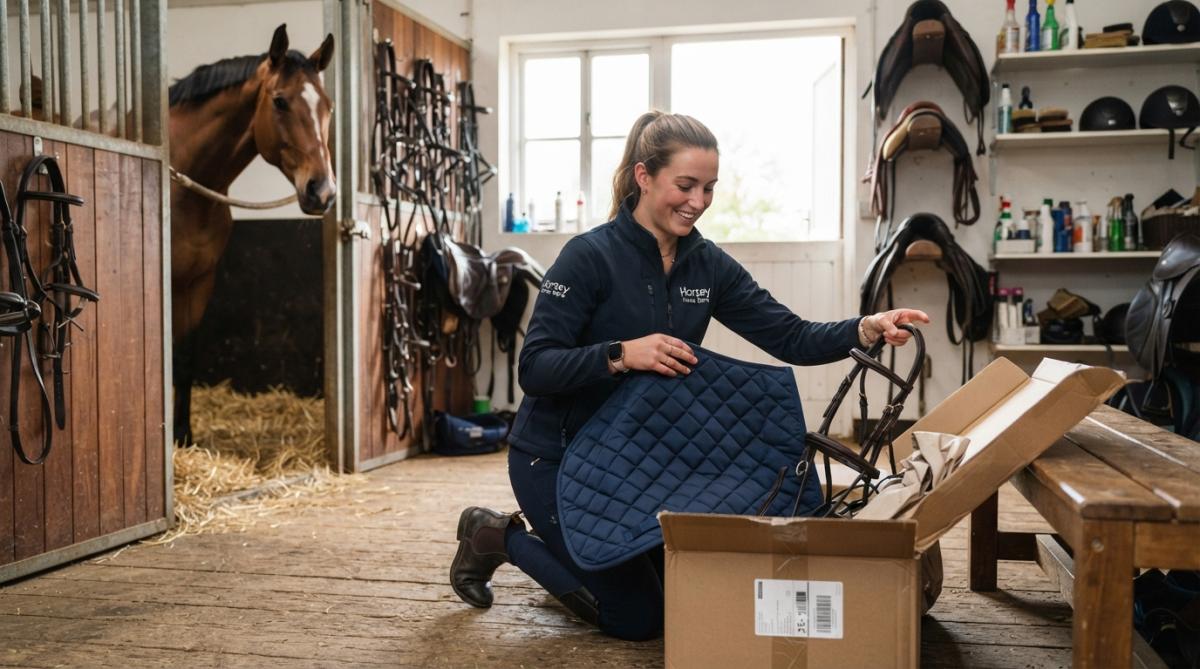
Online tack stores also simplify price comparison. Instead of driving between shops to check prices, you can open a few tabs and see exactly where your budget goes. Many riders find that online pricing is more competitive because larger retailers have lower overhead than brick-and-mortar stores, according to general retail trends tracked by the U.S. Census Bureau’s retail sales data.
What to Look for in a Reliable Online Tack Store
Not every online tack store is created equal. A reliable retailer should offer clear product descriptions, secure checkout, and accessible customer support. You want a store that stands behind its inventory with a practical return policy, so you are not stuck with gear that doesn’t work for your horse.
Before you buy, check the store’s shipping timeline and return window. Free shipping thresholds matter for smaller orders, and a 30-day return policy on clean, unused items gives you breathing room to evaluate a purchase. Secure checkout is non-negotiable for protecting your payment information.
The Federal Trade Commission’s guidance on online shopping reminds consumers to verify a retailer’s contact information and return terms before ordering. A store that lists a physical address and responsive support channels is more likely to resolve issues quickly.
How to Measure for Horse Tack: A Quick Guide
Accurate measurements are the foundation of a good purchase. For bridles, you need the horse’s head circumference and the length from the corner of the mouth, over the poll, to the opposite corner. For girths, measure the heart girth just behind the elbows and add a few inches for adjustment.
Many online tack stores provide a measurement guide with each product page. Use a flexible tape measure and record the numbers twice to avoid errors. If you are between sizes, size up for comfort rather than down for a snug fit.
| Tack Item | Key Measurement | Common Mistake |
|---|---|---|
| Bridle | Head circumference, bit-to-bit length | Guessing size without measuring |
| Girth | Heart girth behind elbows | Ordering too short for adjustment |
| Saddle Pad | Withers height, back length | Ignoring wither clearance |
Saddle Fitting Guide for Online Shoppers: Get It Right the First Time
Saddle fit is the most critical factor in online tack shopping, and it is also the scariest for new buyers. The key is understanding your horse’s back shape and the saddle’s tree width. A saddle fitting guide for online shoppers should start with wither shape: high withers need a narrower tree, while flat-backed horses need a wider cut.
Measure the length from the withers to the last rib to determine the correct saddle size. Then compare that against the manufacturer’s sizing chart. Some online stores offer a fit check before you finalize an order, which is a service worth using.
For a practical example, the Pro Fit Horse Saddle includes a fit and selection check at checkout, letting you confirm tack style, attachment points, and measurements before the order ships. That extra step prevents costly mismatches.

Choosing the Right Horse Bridle Sets and Materials
Material choice in bridles is not just about looks; it is about biomechanics, durability, and safety. The two main categories are traditional leather and modern synthetics, but within those categories, the quality of the raw materials and construction varies dramatically.
Leather: The Traditional Standard
Full-grain leather is the top tier. It retains the natural fiber structure, making it strong and breathable. It molds to the horse's head over time, creating a custom fit. However, it requires regular cleaning and conditioning with products like neatsfoot oil or glycerin soap to prevent drying and cracking. A common failure point is the leather around the buckle holes, which stretches under load if the leather is not properly tanned.
Split leather, often found in budget sets, is a lower grade. It is the layer beneath the full grain, and while it is cheaper, it lacks the tensile strength and will break down faster under stress. A quick test: press your fingernail into the leather. Full-grain will resist; split leather will leave a noticeable indentation.
Synthetics: The Low-Maintenance Alternative
Biothane is a synthetic that has gained a strong following among trail riders and those in wet climates. It is a nylon core coated with a waterproof, wipe-clean polymer. It does not absorb water, sweat, or dirt, which means it will not rot or mildew. It also does not stretch, which is a double-edged sword: it offers consistent contact but will not mold to the horse's head like leather.
Nylon webbing is another option, but its quality hinges on the weave density and the stitching. A 1-inch nylon strap with a loose weave will fray and lose shape. Look for a tight, herringbone weave and bar-tack stitching at stress points.
Hardware: The Silent Safety Feature
Stainless steel is the industry standard for a reason. It resists rust and corrosion. However, not all stainless steel is equal. Look for solid, forged buckles rather than stamped or hollow ones. A solid buckle has a smooth, rounded edge that will not dig into the horse's jaw. A stamped buckle, often found on budget sets, has sharp edges and can bend under pressure, leading to a catastrophic failure while riding.
Safety Certifications and Breakaway Features
This is where most retail articles stop, but it is the most critical part of the buying decision. For any bridle used in a situation where the horse could get caught on something, trail riding, turnout, or cross-country, a breakaway crown piece or a leather headpiece that is weaker than the reins is not a luxury; it is a safety mechanism. The principle is simple: the bridle should be the weakest link in the system so that the horse can free itself if it steps on a rein or catches a branch.
Additionally, check for the presence of a throatlatch. It is not just a decorative strap; it is a critical retention device that prevents the bridle from slipping over the horse's head if the horse shakes violently or rubs its head on a post. A properly fitted throatlatch should be snug enough to allow a fist to fit between it and the jaw, but tight enough to hold the bridle in place.
When evaluating a bridle, ask the retailer directly about the source of the leather and the grade of the stainless steel. The material science behind the tack is what separates a budget bridle from a higher-priced one, and understanding that difference is what keeps your horse comfortable and safe.
What About Shipping, Returns, and Customer Support?
Shipping and returns are where the online shopping experience is won or lost. The baseline is easy to state, free shipping over a threshold and a 30-day return window, but the details of how those policies are executed are what separate a reliable store from a frustrating one.
Shipping Timelines and Fulfillment Mechanics
Many online tack stores operate on a 3 to 5 business day processing window before the carrier even picks up the package. This is different from transit time. A store might advertise "free 5-day shipping," but if it takes 4 days to process the order, you are looking at 9 days total. Before you check out, look for the "ships by" date on the product page. This is the date the store commits to handing the package to the carrier, not the delivery date.
For expedited shipping, understand that "2-day shipping" typically means 2 business days after the carrier receives the package, not after you place the order. If you need a girth for a show on Saturday, ordering on Wednesday with standard shipping is a gamble. You need to calculate the processing time plus the transit time.
The Return Policy Fine Print
A 30-day return policy is common, but the critical details are who pays for return shipping and what condition the item must be in. The Federal Trade Commission's Mail, Internet, or Telephone Order Merchandise Rule requires that a store ship your order within the time frame promised, but it does not mandate free returns.
Ask these three questions before you buy:
- Who pays the return label? Some stores provide a prepaid label; others deduct a restocking fee or make you pay for the return postage. A $15 return shipping fee on a $40 girth is a 37% surcharge.
- What is the condition requirement? "Clean and unused" is the standard, but what does that mean for a saddle pad you tried on your horse for 10 minutes? Some stores accept it; others will reject it if there is any hair or sweat residue. If you are unsure, call the store and ask for clarification on what constitutes "used."
- What is the refund timeline? The store may receive your return and take 5-7 business days to process the refund, which then takes another 3-5 days to appear on your credit card statement. That is a two-week turnaround from the day you ship it back.
Customer Support: The Test Before You Buy
The best test of a store's customer support is not after a problem occurs; it is before you place an order. Send a question via their contact form or call their phone number. Ask a specific question about a product, such as "Does the biothane bridle have a breakaway crown?" or "Can you confirm the gullet width on this saddle?"
Measure the response time and the quality of the answer. A store that responds quickly with a specific, knowledgeable answer is often a good indicator of helpful customer support. A store that responds slowly with a generic answer may be less helpful if issues arise.
Look for a physical address and a phone number on the contact page. A store that only offers a contact form and no phone number is harder to reach when you have a time-sensitive issue. The Federal Trade Commission's guidance on online shopping advises consumers to verify a retailer's contact information before ordering. A store that lists a physical address and responsive support channels is more likely to resolve issues quickly.
Finally, check the store's policy on shipping delays. If a carrier loses a package, does the store reship immediately, or do they make you file a claim with the carrier first?
Make the Switch to Online Tack Shopping Today
Online tack shopping is not about replacing your local tack shop entirely; it is about expanding your options and taking control of your purchasing decisions. Between the wider selection, competitive pricing, and the ability to research materials at your leisure, the benefits are clear.
Horsey Horse Store simplifies this transition with free shipping over $25, a 30-day return policy on clean and unused items, and secure checkout. Our curated selection of practical horse tack, saddles, and barn accessories supports daily schooling and trail prep without the guesswork.
The challenge is finding a retailer you can trust with something as personal as your horse’s equipment. Start with a small order to test the waters, then build from there.
Get started with Horsey Horse Store and refresh your tack room with gear that works as hard as you do.
Frequently Asked Questions
How do online tack stores compare to local retail shops?
Online tack stores generally offer a wider selection and lower prices because they don't carry the overhead of a physical storefront. This means you can compare horse equipment from multiple brands side-by-side without driving between shops. Local stores win for last-minute needs, but for planned purchases like a saddle or horse bridle sets, online shopping gives you better options and often free shipping. Most reputable online retailers also offer 30-day returns, so the risk is low.
How can I ensure the right fit when buying horse tack online?
Start by using a saddle fitting guide for online shoppers and measuring your horse accurately before you order. Always check the store's measurement guide and compare it with your horse's measurements. Look for detailed product photos and read customer reviews about fit accuracy. Choose retailers that offer 30-day returns on clean, unused items, so you can test the fit at home. If you are unsure, contact customer support with your horse's measurements for guidance.
Are online tack stores reliable for high-quality saddles and gear?
Yes, when you choose a retailer with a strong reputation and clear quality standards. Look for stores that provide detailed material specifications and honest product descriptions. Reading customer reviews gives you insight into durability and how products hold up under daily use. A reliable store stands behind its gear, offering secure checkout and a straightforward return policy.