

Table of Contents
- How to Measure Your Horse for a Saddle Before You Start
- How to Fit a Saddle Correctly: Step-by-Step Placement
- Saddle Balance, Panel Contact, and Bridging
- Signs of a Poorly Fitting Saddle You Should Not Ignore
- Troubleshooting Fit for Specific Horse Conformations
- How Saddle Fit Changes Over Time (and What to Do About It)
- DIY Fit Checklist vs. When to Call a Professional Saddle Fitter
- Conclusion
Last Updated: August 15, 2026
How to Measure Your Horse for a Saddle Before You Start
Correct saddle fit starts with measurement before the saddle touches your horse's back. Skipping this step is the most common reason riders end up with saddles that create pressure points, back soreness, and behavioral problems. Saddle fit assessment requires two core measurements: wither profile and gullet width.
Tracing the Wither Profile and Back Shape
Wither tracing is the most reliable DIY tool for matching a saddle tree to your horse's back shape. Use a flexible curve ruler or moldable wire, place it across the withers about 2 inches behind the top of the shoulder blade, and press gently to conform to the horse's contour. Trace the shape onto paper.
Repeat this at three points along the back: at the withers, at the 18th thoracic vertebra (roughly where the saddle back will sit), and midway between. These tracings reveal whether your horse has a flat back, roached back, or swayback, each requiring a different panel contact profile. High, prominent withers need a saddle with a high, narrow gullet. Mutton-withered horses need a wider gullet and flatter panels.
Determining Gullet Width and Tree Bar Angle
Gullet width is the measurement across the inside of the saddle's pommel arch. It determines whether the saddle tree clears the horse's spine and sits correctly on the trapezius muscles.
You should be able to fit three fingers upright between the pommel and the wither when the saddle is in place. However, gullet width alone is insufficient, tree bar angle matters equally. Bars that are too steep will dig into the horse's back; bars too flat will rock side to side. Hold the saddle up and examine the underside. The bars should follow the slope of your wither tracings. If they angle significantly steeper or flatter, that tree is not the right fit regardless of gullet measurement.
How to Fit a Saddle Correctly: Step-by-Step Placement
Proper placement is where most DIY saddle fitting fails.
Positioning the Saddle on the Horse's Back
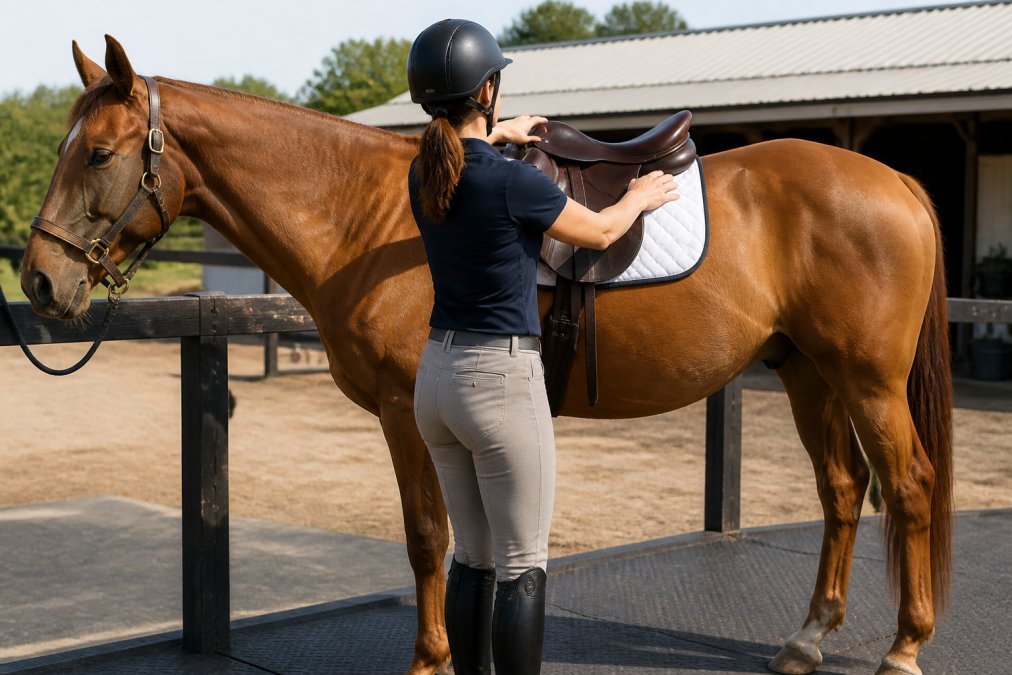
Place the saddle further forward than you think it should go, then slide it backward until it stops naturally. This lets the saddle find its own balance point rather than forcing it into a position that fights the horse's conformation.
The front panel should sit behind the shoulder blade, not on top of it. Slide your hand under the front panel and have a helper lift the horse's foreleg forward. You should feel the scapula rotate freely without catching. If it catches, the saddle is too far forward and will restrict shoulder freedom.
The saddle back should not extend past the 18th thoracic vertebra. Beyond that point, the horse's back lacks bony support and cannot carry load without discomfort. For most horses, the saddle skirt should end roughly where the last rib is.
Checking Wither Clearance and Spinal Clearance
The pommel must clear the withers by at least two to three fingers when a rider is mounted. Check this with weight in the saddle, not empty, many saddles compress onto the withers under load.
Spinal clearance runs the full length of the gullet channel. Looking down the gullet from the back, you should see daylight through to the front with the spine visible but untouched. Run your fingers down both sides of the gullet channel from front to back. The channel must maintain consistent width throughout, not just at the endpoints.
Girth Placement, Billet Alignment, and Elbow Room
The girth should sit in the horse's natural girth groove, typically 2 to 4 inches behind the point of the elbow. Too far back and the saddle slides forward; too far forward and it restricts elbow movement and creates galls.
Billets should hang perpendicular to the ground or angle slightly forward. Billets angling sharply backward indicate either the saddle does not fit or the tree is wrong for this conformation. Watch your horse move on a lunge line after girthing. If the elbow is hitting the girth or stride is shortened on one side, adjust girth position.
Saddle Balance, Panel Contact, and Bridging
The saddle must be level from front to back. Place a level across the seat. The lowest point should be level or slightly lower than the pommel and cantle. A significantly lower cantle suggests the tree is too narrow; a dropped pommel suggests it is too wide.
Testing for Pressure Points and Rocking
Bridging occurs when a saddle makes contact at the front and back panels but lifts away in the middle, concentrating all rider weight at two points. Slide thin cardboard under the panel at several points with the saddle girthed up. At the center, the cardboard should meet resistance. If it slides freely, the saddle is bridging.
Rocking is the opposite: contact in the middle but lifting at front and back. Press down gently on the pommel and then the cantle. Neither should rise when the other is pressed.
The University of Veterinary Medicine Vienna research on equine back biomechanics has documented how uneven panel contact correlates with muscle asymmetry and behavioral resistance.
Signs of a Poorly Fitting Saddle You Should Not Ignore
Behavioral signs often appear before physical changes. Watch for pinning ears or biting when saddled, reluctance at the mounting block, bucking or bolting out of character, shortened stride, cold-backed behavior, asymmetrical sweat patterns, white hairs under the saddle area, or muscle wasting along the topline.
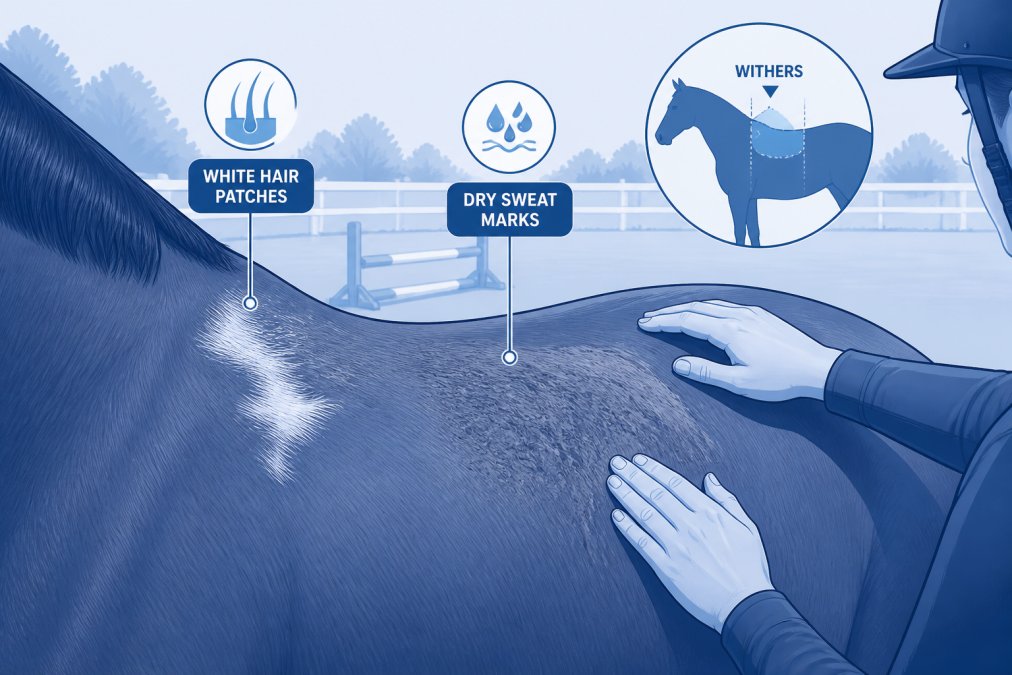
White hair patches indicate chronic pressure damage to hair follicles and are permanent. The saddle fit must be corrected immediately. According to the American Association of Equine Practitioners guidelines on back pain, saddle fit is one of the primary causes of performance-related back soreness in sport horses.
Troubleshooting Fit for Specific Horse Conformations
High-withered Thoroughbreds and Warmbloods need a narrow to medium gullet with a high pommel arch. The biggest risk is wither pressure. These horses also tend to have longer backs and wider shoulders, requiring careful positioning to avoid restricting scapular movement.
Mutton-withered Quarter Horses and drafts need a wider gullet and flatter tree bars. The saddle tends to slide forward due to less wither definition. A breastplate is often necessary for trail riding.
Roach-backed horses need a saddle with a bridging-resistant panel profile and often require custom flocking adjustment. Standard saddles almost always bridge on a roach back.
Swayback horses present the opposite problem: the spine dips in the middle, so a standard flat panel will rock. Saddles with a slightly curved panel or additional foam flocking at the center often fit better.
Young horses change shape dramatically in their first five years. A saddle fitting a three-year-old in light work may not fit the same horse at six after consistent muscling. Plan for annual fit checks during this period.
How Saddle Fit Changes Over Time (and What to Do About It)
Saddle fit is not a one-time event. A horse's back shape changes with age, fitness, season, workload, and diet. A perfectly fitted saddle in spring may not fit the same horse in late summer after six months of conditioning.
Back muscles develop significantly with correct training. As the longissimus dorsi and trapezius build, the horse's back widens and wither profile changes. A saddle correctly fitted to an unfit horse will often sit too narrow once the horse comes into work. Conversely, horses losing condition will lose back muscle and the saddle may become too wide.
| Trigger | Recommended Action |
|---|---|
| Every 6 months (minimum) | DIY fit check |
| Significant weight change | Full fit assessment before resuming work |
| New training discipline | Fit check after 60-90 days of consistent work |
| After injury or layoff | Professional assessment before returning to ridden work |
| Horse aged 3-6 years | Annual professional assessment minimum |
| Behavioral changes under saddle | Immediate fit check |
Flocking in wool-stuffed saddles compresses over time and requires periodic adjustment. A reflocked saddle often feels dramatically different to ride.
DIY Fit Checklist vs. When to Call a Professional Saddle Fitter
Most riders can handle routine saddle fit checks using the steps in this guide.
DIY Saddle Fit Checklist:
- Saddle slides back to natural position when placed forward and released
- Front panel clears the shoulder blade during foreleg extension
- Saddle does not extend past the 18th thoracic vertebra
- Two to three fingers of wither clearance when rider is mounted
- Daylight visible through the full length of the gullet channel
- Saddle sits level
- No bridging (cardboard test passes at center panel)
- No rocking
- Billets hang perpendicular or slightly forward
- Girth sits 2 to 4 inches behind elbow
- Sweat pattern is even and symmetric after work
- No behavioral changes under saddle
Call a professional saddle fitter when the horse shows persistent behavioral problems under saddle, white hairs or muscle atrophy are present, the horse has unusual conformation, you are purchasing a new saddle, the saddle has not been reflocked in more than two years, or you have adjusted fit yourself but the horse still shows discomfort.
The Society of Master Saddlers certification standards for professional saddle fitting provides a useful benchmark for qualified fitters. Certified fitters use pressure mapping technology and dynamic assessment to identify problems that static checks miss.
For riders sourcing new saddles, Horsey Horse Store offers a 30-day return policy, giving you time to do a proper mounted fit check before committing. The American Farriers Journal and equine veterinary resources on saddle-related back pain notes that early intervention on saddle fit problems consistently produces better outcomes.
Saddle fit problems are rarely obvious until they have caused damage. A horse cannot tell you the saddle hurts; it can only show you through behavior and body changes. Horsey Horse Store provides everyday equestrians with a curated selection of practical horse tack, saddles, and essential barn accessories. We focus on delivering high-quality grooming supplies and riding gear designed to simplify your daily routine and enhance your time in the barn. With free shipping on orders over $25 and a 30-day return window, you can evaluate fit properly before making a final decision. Browse the saddle collection and find the right fit for your horse.
Frequently Asked Questions
How do you know if your saddle fits correctly?
A correctly fitting saddle sits level on the horse's back with two to three fingers of wither clearance at the pommel, full panel contact along the horse's back without bridging or rocking, and a clear gullet channel that never touches the spine. The saddle should not shift side to side when the horse moves, and the girth billets should hang straight down. After a ride, sweat marks should be even across both panels with no dry spots indicating pressure points.
What are signs of a poorly fitted saddle?
Common signs of a poorly fitting saddle include uneven or dry sweat patches after riding, white hair patches from chronic pressure, a horse that pins its ears or swishes its tail when being saddled, reluctance to go forward, back soreness when you press along the muscles beside the spine, and a rider who constantly slides forward or back. Bridging, where only the front and rear panels contact the back, is another clear indicator the saddle tree does not match the horse's back shape.
Is it better for a saddle to be too wide or too narrow?
Neither is safe, but a too-narrow saddle causes more immediate harm. Narrow tree bars pinch the withers and restrict shoulder rotation, creating direct pressure on the scapula with every stride. A saddle that is too wide drops onto the withers and spine, removing clearance and concentrating rider weight in the wrong place. If you must choose while waiting for a proper fit, a slightly wide saddle with a correctly fitted pad can be a short-term bridge, but professional adjustment or reflocking should follow quickly.
How do I size myself for a saddle?
Measure from the back of your knee to your seat bone while sitting. English saddle seat sizes generally run from 15 to 18.5 inches; most adult riders fall between 16.5 and 17.5 inches. For a western saddle, measure the same way but expect sizes labeled 14 to 17 inches, as western seats measure differently. You should have roughly four inches between your body and the pommel, and the same gap behind you to the cantle. A saddle that is too small restricts movement; one that is too large shifts your weight incorrectly.
Can a saddle be adjusted if it doesn't fit?
Yes, within limits. A qualified saddle fitter can adjust flocking to change panel shape, replace a gullet plate to widen or narrow the tree on many modern saddles, and rebalance the seat angle. These adjustments can correct minor fit issues or accommodate a horse whose back shape has changed with age, conditioning, or weight. Structural problems with the tree itself, broken or twisted bars, cannot be fixed by reflocking and require the saddle to be retired or sent to a specialist saddler for tree repair.
How often should saddle fit be checked?
Check fit at least twice a year for horses in regular work, and any time a horse gains or loses significant weight, completes a heavy conditioning program, or shows new behavioral changes under saddle. Young horses and those returning from injury or extended rest can change back shape quickly, so quarterly checks make sense for them. A professional saddle fit assessment once a year, combined with your own monthly DIY checks using the steps in this guide, gives you the best chance of catching problems early.
This article was written using GrandRanker