

Table of Contents
- Why Saddle Width Matters for Your Horse
- 7 Clear Signs of a Saddle That Is Too Wide
- How to Measure Horse for Saddle Fit
- Saddle Gullet Width Guide: Finding the Right Size
- The Visual Diagnostic: What to Look For
- Padding and Half Pads: Helpful or a Mask?
- Conclusion: Trust the Fit, Not the Guess
- Frequently Asked Questions
Last Updated: September 8, 2026
Why Saddle Width Matters for Your Horse
A saddle that is too wide is one of the most common causes of back pain, behavioral issues, and poor performance in horses, and identifying a saddle too wide early is key to preventing these problems (aaep.org). When the saddle tree is wider than the horse's back, the panels bridge across the withers and spine rather than distributing weight evenly along the muscles, creating pressure points that make every ride uncomfortable.
Saddle fit is about biomechanics, not aesthetics. The tree must match your horse's back so weight transfers through the panels onto muscle masses, not the spine or withers. A saddle that looks balanced from the ground may fail the real test once the girth is tightened and a rider sits in the seat.
This guide covers the signs of a saddle that is too wide, how to measure your horse accurately, and when padding helps versus when it masks a deeper problem.
7 Clear Signs of a Saddle That Is Too Wide
The clearest indication that a saddle is too wide is instability: it rocks side to side or slides forward when you mount and ride. Because the tree angles are too open for the horse's shape, the saddle cannot grip properly, leading to uneven pressure and friction across the back muscles.
Watch for these seven warning signs during your next ride:
- The saddle rocks or tips when you mount from the ground
- The pommel sits too low, pressing on the withers
- You can see daylight gaps along the panels when viewed from behind
- The saddle slides forward when riding uphill or in transitions
- Your horse develops white hairs or rub marks behind the withers
- The horse becomes reluctant to move forward or hollows its back
- You feel excessive movement under your seat during trot work
Saddle Rocking and Wither Clearance
When a saddle is too wide, the tree points angle outward beyond the shoulder and withers, creating a fulcrum effect where the saddle tips side to side with every stride. Place the saddle on the horse's back without a pad and press gently on the seat; if it rocks like a seesaw, the tree is too wide.
Wither clearance is equally telling. With a correctly fitted saddle, two fingers should slide vertically between the pommel and withers when the girth is tightened (extension.org). Insufficient clearance means the saddle sits on the withers, causing pain, muscle atrophy, and possible permanent spine damage.
Chafing, Soreness, and Behavior Changes
A too-wide saddle moves enough to create friction against the skin, causing chafing behind the elbows, girth sores, and grooming sensitivity. The movement shifts pressure onto soft tissue and spine edges rather than the intended weight-bearing areas.
Behavior changes are often the horse's way of communicating discomfort. A horse that previously stood quietly for mounting may begin to fidget, bite, or swing its hindquarters away. Under saddle, you might notice head tossing, a hollow back, a rushed or uneven rhythm, or outright refusals. The American Association of Equine Practitioners saddle fit resources emphasize that behavioral resistance is frequently traced back to ill-fitting tack before any other cause is investigated.
How to Measure Horse for Saddle Fit
Measuring your horse correctly is the foundation of every saddle fitting decision. You need two measurements: wither width and shoulder angle, typically captured with a flexible wire or a wither tracing gauge.
To measure wither width, stand your horse on level ground with its head neutral. Place a flexible curve ruler across the withers about two inches behind the shoulder blade, press gently to conform, then remove and trace the outline onto cardboard. This tracing shows the angle and width your saddle tree needs.
Measure the shoulder angle with a protractor-style gauge along the shoulder blade and wither. The angle corresponds to tree sizes: narrow around 82 degrees, medium around 90, wide around 96. These numbers vary by manufacturer, so a tracing is more reliable than a guess based on breed.
Saddle Gullet Width Guide: Finding the Right Size
The gullet is the channel underneath the saddle that protects the spine. It should clear the spine entirely, typically one to three inches at the pommel, but remain narrow enough that the panels still contact the back muscles on either side.
Here is a simple reference for how gullet width corresponds to common horse builds:
| Gullet Width | Approximate Angle | Typical Horse Build |
|---|---|---|
| Narrow | 82-88 degrees | Fine-boned, high withers (Thoroughbred, Arabian) |
| Medium | 88-94 degrees | Average build (Quarter Horse, Morgan) |
| Wide | 94-100 degrees | Broad, flat back (draft crosses, some Warmbloods) |
| Extra Wide | 100+ degrees | Very wide, mutton-withered horses |
If your horse falls between sizes, choose the narrower option and use fitting pads to adjust. A slightly narrow saddle can often be made comfortable professionally, while a saddle that is too wide is much harder to correct safely.
The Visual Diagnostic: What to Look For
Most saddle fit guides tell you to "look for gaps" or "check for rocking," but rarely show what those problems look like from the angles that matter. This section is a visual diagnostic checklist you can use at the barn with your phone, turning vague impressions into a repeatable assessment.
The Three-Angle Photo Protocol
Take three photos of your horse tacked up (no rider, girth snug) at the horse's mid-body height to avoid perspective distortion.
-
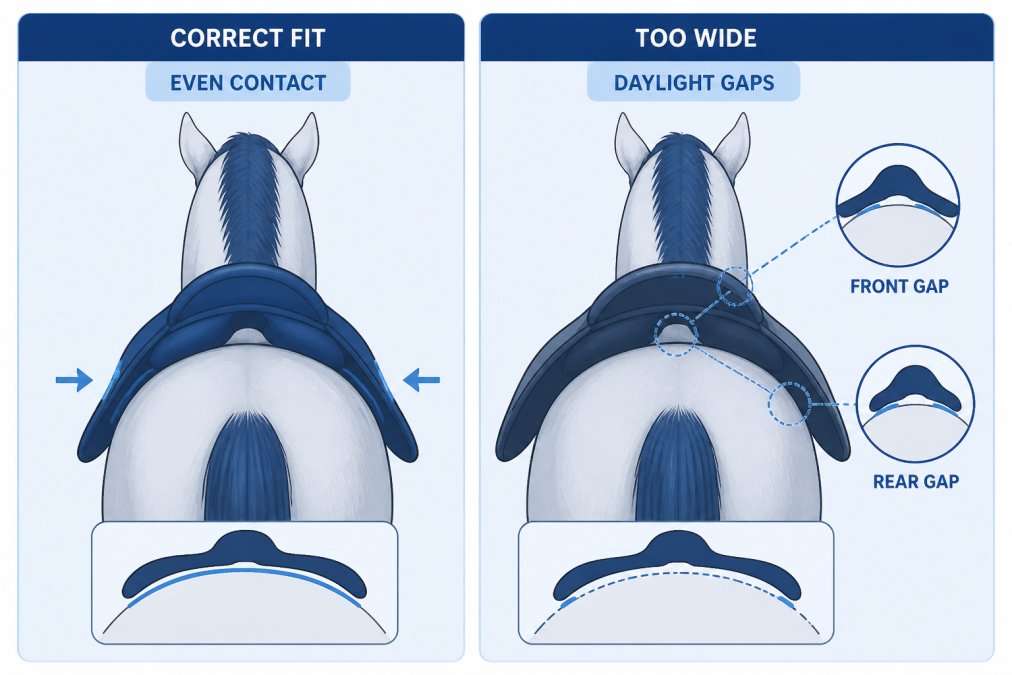
Directly from behind (tail view): Stand 10-12 feet back, centered on the horse's spine. Look at the panel contact along the full length of the saddle. You should see even, flush contact with the back muscles on both sides. A too-wide saddle often shows a telltale "hourglass" shadow: daylight visible at the front of the panels near the withers and again at the rear, with contact only in the middle. That is bridging, and it means the tree angles are too open for the horse's back shape.
-
From the side (profile view): Crouch down so your camera is level with the saddle's seat. The pommel should sit slightly higher than the cantle, roughly a 1-2 degree tilt, which is barely perceptible to the eye but visible in a level photo. If the pommel is lower than the cantle, the saddle is tipping forward onto the withers, a classic sign of a tree that is too wide.
-
From the front (chest view): Stand 8-10 feet in front of the horse, looking straight down the barrel of the saddle. You are checking the gullet channel. You should see a clear, even channel of daylight running from pommel to cantle over the spine. If the channel narrows or disappears at the front, the tree is too wide and the panels are collapsing toward the spine under rider weight.
The Two-Finger and Hand-Flat Tests
These two manual checks take less than a minute and require no tools.
-
Wither clearance (two-finger test): With the girth tightened and no rider, slide two fingers vertically between the pommel and the withers. The fingers should slide in with light contact but not pinch. If you cannot get two fingers in, the saddle is sitting on the withers. If you can get three or more fingers in with room to spare, the tree is likely too narrow, not too wide, and you should check the signs in the next section.
-
Panel contact (flat-hand test): Slide your flat hand between the panel and the horse's back, starting at the front of the panel and moving toward the rear. You should feel even, consistent contact along the entire panel. A too-wide saddle will show a gap at the front of the panel (where the tree points flare away from the shoulder) and again at the rear, with pressure concentrated in the middle. This is the same bridging pattern you saw in the tail-view photo.
The Rocking Test: Static vs. Loaded
A saddle that rocks with no rider is obviously too wide, but many only reveal the problem under load. Test both conditions:
-
Static test: Place the saddle on the horse's back without a pad. Press firmly on the center of the seat with one hand. If the saddle tips side to side like a seesaw, the tree is too wide. A correctly fitted saddle should feel stable and planted.
-
Loaded test: Mount up and sit in the saddle with your weight in the stirrups. Have a helper stand behind the horse and watch the panels. If the saddle rocks or shifts side to side as you settle into the seat, the tree is too wide even if the static test felt stable. This loaded rocking is often the first sign riders notice as a "loose" feeling under the seat during trot work.
Documenting Changes Over Time
Saddle fit changes as muscle tone changes; a horse coming out of winter turnout with less top-line muscle may suddenly find its saddle too wide. Take the three-angle photo set once a month on the same horse in the same condition and compare panel contact and wither clearance to catch developing problems early.
Padding and Half Pads: Helpful or a Mask?
Padding is the most misunderstood tool in saddle fitting. Riders reach for a thicker pad when a saddle feels loose, hoping to fill a gap the pad cannot fill. If the tree is too wide, the tree points flare outward and the panels bridge; a pad does not change the tree angle. It only raises the saddle higher off the back, increasing the fulcrum effect and worsening the rocking.
What Padding Can and Cannot Do
A half pad or fitting pad is a legitimate tool for three specific situations:

-
Minor asymmetry: If your horse is slightly uneven from left to right, common after an injury or in horses with a history of poor shoeing, a half pad with removable shims can level the saddle. This is a fine-tuning adjustment, not a width correction.
-
Muscle atrophy recovery: A horse coming back from a prolonged layoff may have lost top-line muscle, making a previously correct saddle feel slightly loose. A pad can bridge a short-term gap while you rebuild muscle through correct work. This is a temporary measure, not a permanent fix.
-
Saddle fit between professional fittings: If your saddle fitter has confirmed the tree is correct but you are waiting for an adjustment (such as reflocking), a half pad can provide short-term comfort. The key word is short-term.
What padding cannot do is fix a tree that is fundamentally too wide. No thickness of wool, foam, or air changes the angle of the tree points; a too-wide saddle will still rock, bridge, and press on the spine. The pad only delays the diagnosis.
The Thicker Pad Paradox
Thick pads (1 inch or more) can make a too-wide saddle feel worse while appearing to fix it. The pad lifts the saddle higher, raising the center of gravity and increasing the leverage of the rider's weight on the tree points, which worsens rocking. It also fills the visual gap so the saddle looks like it fits, but pressure on the spine and instability are actually worse.
A common pattern: a rider adds a thick pad, rides for a few weeks, and the horse is still sore. The pad seemed to help for a ride or two due to added cushioning, but the rocking and bridging never stopped. The pad was never the right tool for the problem.
The Rider's Clothing Angle: Chamois and Breeches
Your own clothing changes how you perceive saddle width. The padding in your breeches affects how much feedback you feel from the seat; a rider in thin breeches will feel the rocking of a too-wide saddle much sooner than one in thick, gel-padded tights, where the chamois absorbs small movements until the problem is advanced.
This is not just comfort. When you cannot feel the saddle moving, you grip with your thighs to stabilize, tensing hip flexors and blocking your following seat. The horse then carries a rider braced against instability, compounding back pain. If you ride in heavily padded breeches and suspect a fit problem, try your thinnest pair, the difference in feedback is often startling.
The Half Pad Test: A 10-Minute Diagnostic
Before buying any pad, run this test to determine whether padding can help:
- Saddle your horse without a pad. Tighten the girth and perform the rocking test from the visual diagnostic section.
- If the saddle rocks or bridges with no pad, add your thickest pad and repeat the test.
- If the saddle still rocks or bridges with the pad, the tree is too wide. No pad will fix it.
- If the saddle is stable without a pad but you have a minor gap issue, a half pad may help. Try it and re-check the panel contact from behind.
A quality half pad like the HORZE Fur Half Pad can help with minor asymmetry or muscle atrophy recovery, but it should never be the solution for a tree that simply does not match your horse's back. The pad is a fine-tuning tool, not a substitute for correct saddle fit.
Conclusion: Trust the Fit, Not the Guess
Determining whether a saddle is too wide comes down to observation, measurement, and honesty. If your saddle rocks, bridges, or presses on the withers, no riding skill will compensate for your horse's discomfort. The fix is straightforward: measure your horse's back, compare it to a gullet width guide, and invest in a saddle that matches its true shape.
At Horsey Horse Store, we understand that saddle fit is critical to your horse's comfort and your enjoyment of riding. Our Pro Fit Horse Saddle is designed for everyday schooling and trail riding with a tree that accommodates a range of common builds, and our 30-day returns give you the confidence to try it at home. Pair it with a quality pad from our dressage saddle pad collection.


Frequently Asked Questions
What are the symptoms of a poor saddle fit?
Common symptoms include white hairs or rub marks behind the withers, uneven sweat patterns under the saddle, back soreness when you groom or tack up, and behavior changes like tail swishing, ear pinning, or bucking under saddle. A saddle that is too wide often rocks from side to side and pinches the horse's shoulders, which shows up as shortened strides or reluctance to move forward.
What is the 3-finger rule for saddle fit?
The 3-finger rule checks wither clearance, not gullet width. Slide three fingers vertically between the pommel and the horse's withers. If you cannot fit three fingers, the tree may be too narrow. If you can fit your whole hand, the saddle is likely too wide. This quick check gives you a starting point, but you should still confirm the fit with a full assessment.
Can a saddle that is too wide cause back pain in horses?
Yes. When a saddle is too wide, the tree does not sit correctly and the panels can bridge, putting pressure on the spine instead of distributing weight across the back muscles. Over time, this causes muscle soreness, stiffness, and even behavioral resistance. The horse may also develop a hollow back or show pain when you cinch the girth.
How do I know if my saddle gullet is too wide?
Check the gullet clearance by looking from the front. You should see even clearance along the gullet channel, with the panels sitting flat on either side of the spine. If you can see the saddle sitting low with the pommel pressing down, or if the saddle rocks, the gullet is probably too wide. A professional saddle fitter can confirm this for you.
Getting the fit right transforms your rides from a battle against friction and pressure into a partnership built on comfort. Measure carefully, trust the visual signs, and when in doubt, choose the saddle that matches your horse's back rather than the one that looks best on the rack. Get started with Horsey Horse Store and give your horse the comfortable foundation it deserves.