

Table of Contents
- Why Multi-Horse Owners Need a Different Gear Strategy
- Feature Comparison: Storage Solutions for Multiple Saddles
- Saddle Storage: Wall-Mounted Racks That Maximize Space
- Grooming Gear: One Kit per Horse or Shared Supplies?
- Horse Tack Organization Ideas for Busy Barns
- How to Label Horse Gear for Quick Identification
- Essential Barn Supplies Checklist for Multiple Horses
- Budgeting for Multi-Horse Maintenance
- Frequently Asked Questions
Last Updated: September 4, 2026
Managing gear for one horse is straightforward. For multiple horse owners, however, it quickly becomes a logistical puzzle of mismatched bridles, misplaced brushes, and stacked saddles. The problem isn't buying quality tack; it's organizing it so every horse and rider can find what they need without a daily scavenger hunt. At Horsey Horse Store, we provide everyday equestrians with a curated selection of practical horse tack, saddles, and essential barn accessories designed to simplify your daily routine and enhance your time in the barn.
Most guides focus on what to buy first. The real challenge is how to store, label, and maintain that equipment so it lasts. Below, we'll show you how to set up a system that works for two horses or ten, covering saddle storage, grooming kits, labeling, and budgeting, plus the common mistakes that lead to wasted money and damaged tack.
Why Multi-Horse Owners Need a Different Gear Strategy
The biggest mistake multi-horse owners make is treating their barn like a collection of single-horse setups. You need a system for equine care that prioritizes standardization and shared infrastructure. Buying a unique grooming kit and saddle for each horse without a plan for where they live creates chaos.
A smarter approach is to think in terms of zones: a tack wall for saddles and bridles, a grooming corner with individual toolboxes, and a feed room with clearly labeled bins. This reduces time spent searching for a curry comb and prevents the spread of skin conditions through shared brushes. A dedicated space for each category of gear is more efficient than a single pile.
Feature Comparison: Storage Solutions for Multiple Saddles
Choosing the right saddle storage depends on your barn's wall space, the number of saddles you own, and your budget. Wall-mounted racks are the most space-efficient option for multi-horse barns because they keep saddles off the floor and out of the way. The table below compares three solid options for different barn sizes.
| Rack Option | Price | Capacity | Best For |
|---|---|---|---|
| Paterr Wall-Mount Rack Set | $107.99 | 2 saddles | Small barns with 2-3 horses |
| GOLASON 3-Tier Rack | $163.99 | 3 saddles | Medium barns needing vertical storage |
| VEVOR 8-Pack Rack Set | $462.87 | 8 saddles | Large barns or boarding operations |
Saddle Storage: Wall-Mounted Racks That Maximize Space
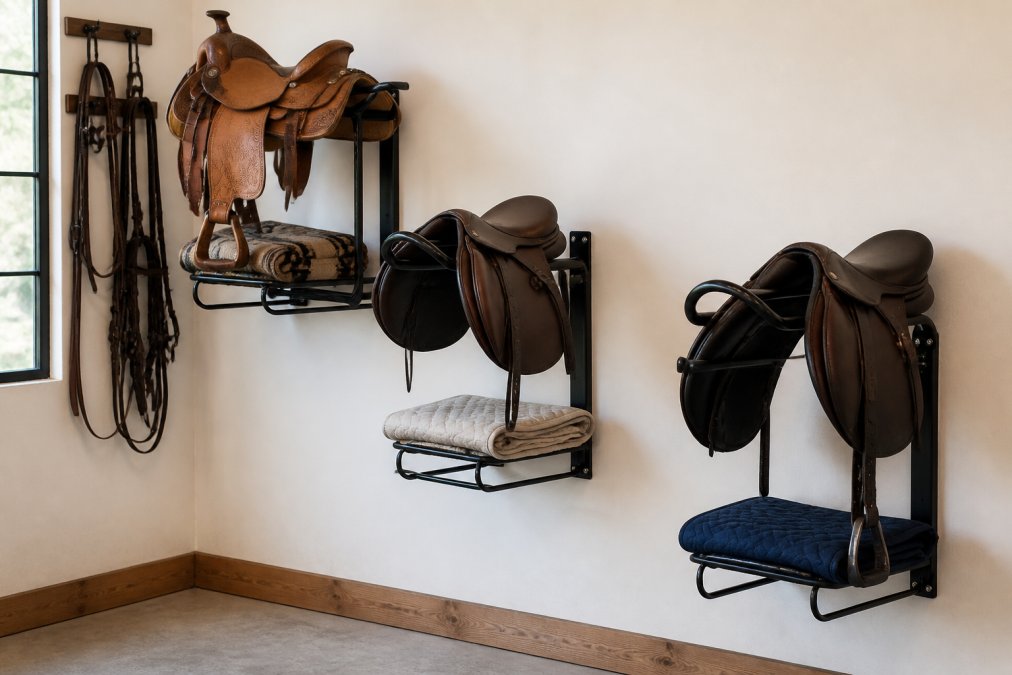
Wall-mounted racks are the undisputed winner for horse tack organization ideas in multi-horse barns. They convert unused vertical wall space into prime real estate, keeping valuable saddles elevated and protected from moisture, rodents, and accidental kicks. When mounting, always secure the rack into wall studs, not just drywall, to safely hold the weight of a saddle.

GOLASON 3-Tier Wall-Mounted Saddle Rack
This is the best pick for a barn with three or more saddles but limited floor space. The GOLASON 3-Tier Wall-Mounted Saddle Rack costs $163.99 and holds three saddles vertically, which is ideal for a narrow aisle. It handles both English and Western styles, and the tiered design keeps each saddle separated to prevent scuffs. The gold finish is a nice touch, but the real value is the space savings.
Paterr Wall-Mount Saddle Rack Set
For those just stepping up to two horses, the Paterr Wall-Mount Saddle Rack Set is the most budget-friendly entry point at $107.99. This set comes with two separate single-bar racks, giving you flexibility to mount them side-by-side or on opposite walls. The silver, one-bar design is simple and functional, and it also includes a pad bar to keep saddle pads or blankets organized.
VEVOR Wall-Mount Saddle Rack Set
Large barns and lesson programs need the VEVOR Wall-Mount Saddle Rack Set. At $462.87, this 8-pack is the most cost-effective per-rack solution for serious operations. It provides a dedicated spot for up to eight saddles, which is essential for maintaining equipment standardization across a busy barn. The portable stands can also be moved if you reconfigure your tack room layout.
Grooming Gear: One Kit per Horse or Shared Supplies?
The best practice for multiple horses is to have a dedicated grooming kit per horse, but a shared supply of bulk items like shampoo and hoof conditioner. Individual kits prevent the spread of ringworm and other fungal infections, which is a real risk when brushes are shared between horses (PubMed). A common approach is to assign each horse a colored tote or box that stays in their stall or a designated spot on the grooming wall.
For a cost-effective setup, the 10-Piece Horse Grooming Kit at $59.99 is an excellent starter option for each horse. It includes the essentials: a curry comb, body brush, hoof pick, and a tote bag for easy transport. If you prefer a more permanent station, the 8-Piece Horse Grooming Box Kit at $190.99 comes in a rigid plastic toolbox that can be labeled and mounted or stacked neatly in the grooming corner.

Horse Tack Organization Ideas for Busy Barns
Generic advice about pegboards falls apart when you're managing tack for three or more horses. The real challenge isn't finding a hook; it's building a system that prevents cross-contamination, speeds up daily turnout, and scales with your herd. The most effective barns move beyond simple hooks to a zone-based layout that separates each horse's gear into a dedicated, color-coded station.
The Zone System: A Tack Room Layout for 2+ Horses
Divide your tack room into three distinct zones to prevent the morning rush from becoming a free-for-all and ensure every item has a permanent home.
- The Saddle Zone: Dedicate one wall or a freestanding rack to saddles. Mount a bridle hook directly above or beside each saddle rack. This creates a complete "station" for each horse, so you grab the saddle and bridle together without walking back and forth.
- The Grooming Zone: This is a separate area with a washable floor or mat. Install a wall-mounted grooming caddy or a simple shelf for each horse's tote. Keep bulk items like shampoo and hoof conditioner on a higher shelf, out of reach of the individual totes, to prevent accidental sharing.
- The Community Zone: This is for items that are safely shared or used by multiple horses, such as lunge lines, lunge whips, bell boots, and extra lead ropes. Use a single, clearly labeled pegboard or a large bin. This zone is critical for preventing duplication and saving money.
Space-Saving Hacks for Small Tack Rooms
Multi-horse owners often struggle with limited space. Here are three specific hacks:

- Vertical Bridle Storage: Instead of a horizontal bridle rack that takes up wall width, use a vertical bridle holder. These can hold 4-6 bridles on a single narrow strip of wall, stacking them vertically to free up prime wall space for saddle racks.
- Over-the-Door Organizers: A heavy-duty, over-the-door shoe organizer with clear pockets is a low-cost, high-density solution for smaller items. Use it to store fly masks, splint boots, and bell boots. Assign one column per horse, and you can instantly see if a horse is missing a boot.
- Ceiling-Mounted Hay Net Storage: For bulky items like hay nets, install a few heavy-duty hooks on the ceiling of the tack room or feed area. Hang the nets by their drawstrings to keep them off the floor, dry, and out of the way of foot traffic.
Standardization: The Key to a Clutter-Free Barn
The single most effective organizational strategy is equipment standardization. When you buy the same brand and model of halter, lead rope, and saddle pad for each horse, you unlock several efficiencies:
- Interchangeable Parts: If a buckle breaks on one halter, you can swap it with a spare from your inventory without worrying about a color or size mismatch.
- Simplified Inventory: You only need to stock one type of replacement part, not five different sizes or styles.
- Visual Clarity: A uniform look makes it immediately obvious when a piece of gear is out of place. A red halter in the blue horse's stall is a clear signal that something was mixed up.
To differentiate between identical items, use the color-coding system described in the next section. This combination is what separates a chaotic barn from an efficient one.
How to Label Horse Gear for Quick Identification
Labeling is the single most effective way to prevent gear mix-ups. You need a system for how to label horse gear that is durable and visible. Use waterproof, color-coded tags or heavy-duty tape with the horse's name written in permanent marker.
- Color Coding: Assign each horse a color (e.g., red for Star, blue for Duke). Use that color for their halter, lead rope, grooming tote, and saddle pad.
- Direct Labeling: Write the horse's name directly on the underside of saddle pads and on the crownpiece of their bridle with a fabric marker.
- Bin Tags: Use laminated tags for feed bins and supplement containers to protect against moisture and fading.
Essential Barn Supplies Checklist for Multiple Horses
Creating an essential barn supplies checklist is crucial for budgeting and ensuring you never run out of necessities. For a multi-horse operation, you must buy in bulk to save money and time.
- Grooming & Health: Curry combs, hard brushes, soft brushes, mane and tail combs, hoof picks, hoof conditioner, and a thermometer.
- Fly Control: Fly spray, fly masks, and fly sheets for each horse, as flies can cause significant irritation and health issues.
- Tack & Handling: A halter and lead rope per horse, plus a few extra for guests or emergencies.
- Feeding: Slow feed hay nets are a game-changer for managing weight and boredom. The 8 PCS Slow Feed Hay Net at $162.99 is ideal for a multi-horse barn, while the Hay Net for Horses Slow Feeder at $35.99 is perfect for individual use or trailering.
Budgeting for Multi-Horse Maintenance
Budgeting for multiple horses requires a shift from per-item thinking to a per-horse annual cost model. Separate your budget into one-time capital expenditures (tack, saddle racks, grooming boxes) and recurring consumable costs (feed, fly spray, shampoo, hoof conditioner, and replacement parts).
The Scaling Cost Multiplier
Costs do not scale linearly. While feed and hay scale directly with the number of horses, many tack and supply costs scale at a lower rate due to bulk purchasing and shared infrastructure. However, veterinary care and farrier visits are fixed per horse and scale linearly. To build an accurate budget, calculate the following per-horse annual costs and then multiply:
- Feed & Hay: This is your largest recurring cost. Estimate $1,500 to $3,000 per horse per year, depending on forage quality and grain needs (extension.org).
- Farrier: Budget $600 to $1,200 per horse per year for trims every 6-8 weeks.
- Veterinary: Set aside $500 to $1,000 per horse per year for routine care, vaccinations, and dental floats.
- Consumables (Fly Spray, Shampoo, Hoof Conditioner): Plan for $150 to $300 per horse per year.
The Bulk-Buying Break-Even Point
Buying in bulk only saves money if you use the product before it expires or degrades. For fly spray, a gallon jug is often the most cost-effective option, but only if you have enough horses to use it within a single season. A good rule of thumb is to buy the largest size only if you have three or more horses; for two, buying two quarts prevents waste from a half-used gallon sitting over the winter.
The Standardization Savings Account
Equipment standardization is not just an organizational tool; it is a direct cost-saving strategy. When you buy the same halter, lead rope, and saddle pad for each horse, you create a single inventory of spare parts. Instead of keeping a spare for each unique color or size, you keep one or two spares that fit any horse, reducing upfront inventory cost and preventing mismatched emergency replacements.
A Practical Budgeting Framework
To avoid financial shock, use this simple framework:
- Calculate Your Fixed Per-Horse Costs: Add up feed, farrier, and vet costs. This is your non-negotiable baseline.
- Calculate Your Shared Infrastructure Costs: Divide the cost of shared items (saddle racks, community lunge lines, bulk fly spray) by the number of horses to understand the true per-horse cost of these investments.
- Build a Replacement Fund: Set aside 5-10% of your total annual budget for gear replacement. Saddle pads wear out, bridle leather cracks, and halters break. Having a dedicated fund prevents you from scrambling for cash when a critical piece of tack fails.
Frequently Asked Questions
What is the most efficient way to organize tack for multiple horses?
The most efficient approach is to assign each horse a dedicated zone or color. Mount saddle racks on the wall with the horse's name above, and keep that horse's bridle, pads, and grooming tools in labeled bins directly below. This eliminates guesswork during busy mornings and keeps gear from getting mixed up. Wall-mounted racks free up floor space, and standardized equipment makes it easier to swap gear between horses when needed.
Should you share grooming kits between horses?
Sharing grooming kits between horses is acceptable for basic brushes, but you should use separate hoof picks, mane and tail combs, and any items that touch the eyes, mouth, or skin folds to prevent spreading fungal infections. A practical compromise is to keep a shared supply of curry combs and hard brushes for everyday dust removal, then assign each horse its own soft brush, towel, and hoof care tools. Label each kit clearly to avoid mix-ups.
How do you keep track of grooming supplies for different horses?
Color-coding is the fastest way to track grooming supplies across multiple horses. Assign each horse a color, then buy brushes, buckets, and towels in that shade or add colored tape to handles. Store each horse's kit in a dedicated caddy or box on a labeled shelf. When you have three or more horses, a wall-mounted grooming station with hooks and labeled bins prevents supplies from migrating between stalls.
What are the best space-saving storage solutions for equestrian gear?
Wall-mounted saddle racks are the best space-saver because they use vertical wall space instead of floor area. A 3-tier rack like the GOLASON model holds multiple saddles in the footprint of one freestanding stand. Add wall hooks for bridles and lead ropes, plus clear bins for smaller items like bell boots and fly masks. This keeps everything visible and accessible without cluttering aisles or stalls.
This article was written using GrandRanker