

Last Updated: October 29, 2026
Quick Summary
A wooden saddle stand is a freestanding or wall-mounted rack that keeps your saddle upright and off the ground, where it stays cleaner and drier. Choose freestanding for open floor space and wall-mounted for small or crowded tack rooms.
- Freestanding stands suit open floor space, and renters who cannot mount hardware into walls.
- Wall-mounted racks keep the floor clear and keep saddles off the ground where dust and moisture collect.
- Measure seat width, seat depth and skirt drop before buying, rather than relying on overall dimensions.
- Check pivot bolts and locking braces on a folding rack before each use, and never fold it with a saddle on it.
- Subtract pads and blankets from any listed load rating, since capacity is per stand.
Table of Contents
- Freestanding Saddle Stand vs. Wall-Mounted Saddle Rack
- Wall-Mounted Saddle Rack Options for Small Barns
- Collapsible Wood Saddle Rack Designs and How They Hold Up
- Western Saddle Rack Fit: Matching Size and Load to Your Saddle
- Comparing Our Saddle Racks by Use Case and Price
- Choosing Your Saddle Stand and Placing Your Order
- Frequently Asked Questions
If you are looking for a wooden saddle stand for sale, you are probably tired of tossing your saddle on a rack, a stall door or the floor. A freestanding wood saddle rack keeps your tack upright and off the ground. A saddle left out often gets dusty and can dry out over time. A dedicated stand keeps your tack off the ground, out of the way and easy to find.

Wooden stands can also suit the way many riders store equipment, giving the saddle a stable, upright resting place. The seven options below cover freestanding models, wall-mounted racks and a collapsible design so you can match a stand to your barn layout and budget.
Freestanding Saddle Stand vs. Wall-Mounted Saddle Rack
Freestanding and wall-mounted saddle storage both keep a saddle off the ground, in different ways. A freestanding stand sits on the floor, while a wall-mounted rack attaches to a wall.
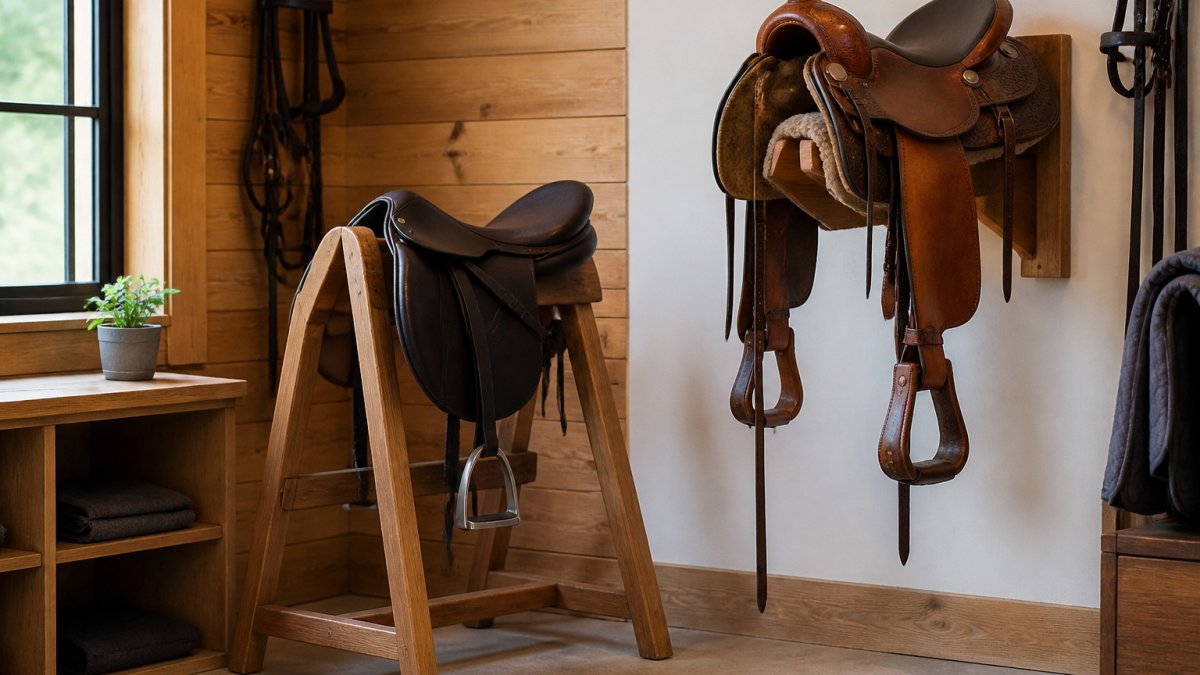
The right choice usually depends on your floor space and how often you move your saddles around.
When a Freestanding Model Makes Sense
A freestanding stand works well if you have open floor space in a tack room or grooming area and you want to move it when needed. It is also a practical choice for renters who cannot mount hardware into walls.
When a Wall-Mounted Rack Saves Floor Space
A wall-mounted rack is the better pick for small barns and crowded tack rooms. It keeps the floor clear for grooming, and it keeps saddles off the ground where dust and moisture collect.
Wall-Mounted Saddle Rack Options for Small Barns
Our wall-mounted options include the GOLASON 3-Tier Wall-Mounted Saddle Rack at $164.99, a three-tier wall-mounted rack. The Paterr Wall-Mount Saddle Rack Set at $148.99 includes a pad bar.

The VEVOR Wall-Mount Saddle Rack Set at $462.87 includes eight pieces. Before you buy any wall-mounted rack, check that your wall can support it and that the mounting hardware suits your wall.
Collapsible Wood Saddle Rack Designs and How They Hold Up
A collapsible saddle rack earns its place when floor space is shared: a trailer, a multi-use grooming bay, a tack room that doubles as a feed room. Folding racks have moving joints that can wear over time. You can check the portable folding saddle stand covered here for its locking design. Understanding how the mechanism works tells you whether a given rack will hold up in your barn.

How folding racks actually fold
Most collapsible wooden racks use one of two mechanisms:
- Hinged legs that swing flat against the body. The legs pivot on bolts or pins and lock open with a brace, a pin, or a friction catch. This design is simple and repairable, but the pivot bolts loosen with repeated folding.
- A scissor or X-frame that collapses vertically. The frame crosses in the middle and folds down to a flat bundle. These pack smaller but put more stress on the central pivot, which is the part to inspect first.
Either way, the rack is only as rigid as its locking points. A rack with a positive lock, such as a pin that drops through aligned holes, holds a loaded saddle more securely than one that relies on friction alone.
What to inspect before each use
A quick check takes under a minute and catches the failures that lead to dropped saddles:
- Pivot bolts and pins. Look for backing-out, stripped threads, or elongation of the holes. A bolt that has started to wallow out its hole will keep loosening no matter how often you tighten it.
- Locking braces. Confirm the brace is fully seated and the pin or catch is engaged. A half-locked brace is the most common cause of a folding rack collapsing under load.
- Hinge screws in the wood. Screws driven into end grain pull out over time. If you can turn a screw with light finger pressure, it needs a longer screw or a through-bolt.
- Feet and floor contact. Wobble at the base multiplies stress on the joints above it. Add a shim or a rubber foot pad if the rack rocks on an uneven floor.
Stability and safe loading
A folding rack has a narrower footprint than a fixed freestanding stand, so it tips more easily. Load the saddle centered over the base rather than hanging it off one side, and keep heavy pads and blankets off the folding model unless the listing states a capacity that accounts for them. On a smooth concrete floor, rubber feet or a thin mat under the legs make a noticeable difference.
Wood care and moisture in a working barn
Wood moves with humidity, and a folding rack's joints feel that movement first. In a barn that swings between damp winters and dry summers, sealed or painted wood resists swelling better than bare lumber, and a coat of paste wax on the contact surfaces keeps moisture out and protects the saddle leather from dye transfer. Wipe down the rack when it gets dusty, keep it off wet floors, and store it folded and dry rather than damp. Check the joints after any stretch of high humidity; that is when loose hardware shows up.
Western Saddle Rack Fit: Matching Size and Load to Your Saddle
Fit is the single most common reason a saddle stand gets returned or sits unused in a corner. The problem is that most listings give you a stand's overall dimensions but not the two numbers that actually matter: the width of the cradle where the saddle rests and the height of the support surface. Before you order, measure your saddle and compare those numbers to the stand.
Measure the saddle, not the horse
You need three measurements, and a soft tape measure works better than a rigid one:
- Seat width at the widest point of the tree. Run the tape across the front of the saddle, just behind the pommel, at the widest part of the tree. Saddle width varies by saddle type and tree, so measure your own saddle before choosing a stand. A cradle that is too narrow concentrates the saddle's weight on a small area and can press the panels or fleece flat over time.
- Seat depth, front to back. Measure from the base of the pommel to the top of the cantle. This tells you how long the cradle needs to be so the saddle sits level rather than tipping forward or back.
- Skirt and fender drop. On a Western saddle, the skirts and fenders hang below the tree. If the stand's cradle is too high or the arms are too close together, the fenders bunch and the leather creases where it folds.
Match the cradle shape to the saddle type
If you own both English and Western saddles, look for a stand described as dual-fit, and confirm the cradle width against each saddle before buying.
Check the load rating and the support points
Weight capacity matters most for Western saddles, which are heavier than English tack, and for any stand holding more than one saddle. If a listing states a load limit, treat it as a per-stand figure and subtract the weight of pads and blankets you plan to hang on the same rack. Where no rating is published, look at the joinery: through-bolts and cross-bracing at the base handle load better than screws driven into end grain.
Support shape matters as much as capacity. A cradle that contacts the saddle along the bars spreads the load; a narrow bar that contacts only the center of the tree creates a pressure point. Padded contact surfaces protect leather, but the padding should be firm enough that the saddle does not sink and rock.
Clearance and placement
Leave enough room around the stand for the saddle to sit without touching a wall, and keep the cantle clear so it does not rest against a shelf or hook. In a grooming area, position the stand so you can lift the saddle on and off without twisting, and keep it out of the path where horses are tied. A stand that fits the saddle but sits in a high-traffic spot will still get knocked over.
Comparing Our Saddle Racks by Use Case and Price
Here is a quick side-by-side view of the five racks in our catalog:
| Rack | Price | Type | Best For |
|---|---|---|---|
| Wood Saddle Rack Stand | $130.99 | Freestanding wood | Tack rooms with floor space |
| HDYEGY Folding Saddle Rack | $124.99 | Collapsible | Shared or multi-use spaces |
| GOLASON 3-Tier Wall Rack | $164.99 | Wall-mounted, 3 tiers | Small barns, stacked storage |
| Paterr Wall-Mount Set | $148.99 | Wall-mounted with pad bar | Saddles plus pads and blankets |
| VEVOR Wall-Mount Set | $462.87 | Wall-mounted, 8 pieces | Large barns and multi-horse setups |
If you are buying for a single horse, the freestanding wood stand or the folding model are both options to compare on price. For a busy barn, the wall-mounted sets are worth considering.
Choosing Your Saddle Stand and Placing Your Order
Start by measuring your floor space and the wall space available. Decide whether you need a freestanding stand or a wall-mounted rack, then compare the saddle types you own. Check the listed dimensions against your room, and confirm the option you want, such as color or piece count, before checkout.
Our store offers free shipping on orders over $25, 30-day returns on clean, unused items, and secure checkout. Choose the stand that fits your space, add it to your cart, and get your saddles off the floor.
Frequently Asked Questions
What should I look for in a wooden saddle stand?
Check the dimensions against your saddle's seat and tree width, confirm the stand can carry the saddle's weight, and look at the finish and joinery. Our Wood Saddle Rack Stand lists wood as its material and is priced at $130.99, with free shipping on orders over $25 and 30-day returns on clean, unused items. Because no exact measurement is published for that model, compare the product photos with your saddle before ordering.
Are freestanding or wall-mounted saddle racks better?
Freestanding racks suit barns with open floor space and let you move the stand when needed. Wall-mounted racks keep saddles off the floor and out of the way in tight tack rooms. Our GOLASON 3-Tier Wall-Mounted Saddle Rack is priced at $164.99, and the HDYEGY Folding Saddle Rack Stand is priced at $124.99.
Can a wooden saddle stand hold a Western saddle?
Many saddle racks are designed for both English and Western saddles, but the fit depends on the saddle's width and the rack's arm or bar spacing. Measure the saddle's seat and fork before choosing a rack. The HDYEGY model lists dimensions of 28 L x 19 W x 37.5 H inches for checking clearance.
How much space does a saddle stand need?
Measure the floor or wall space before you buy. The HDYEGY Folding Saddle Rack Stand measures 28 L x 19 W x 37.5 H inches, so it needs a footprint of roughly 2 by 1.6 feet. The VEVOR Wall-Mount Saddle Rack Set lists 27.3 x 16.3 x 12.5 inches, which is a shallower wall-mounted footprint. Allow extra clearance so you can lift saddles on and off without bumping walls or doors.
