

Table of Contents
- Riding Breeches vs Riding Tights: Core Differences
- How Riding Breeches Should Fit for Comfort and Control
- Full Seat vs Knee Patch Breeches: Which Grip Style Suits You
- Fabric Weight, Stretch, and Breathability: What Matters
- Best Riding Tights for Beginners: Structure and Support
- Riding Tights for Summer: Staying Cool in the Saddle
- Durability, Care, and Real-World Value
- Frequently Asked Questions
Last Updated: October 16, 2026
Riding Breeches vs Riding Tights: Core Differences
Riding breeches vs riding tights explained comes down to structure, grip, and how each garment supports your seat and movement in the saddle. At Horsey Horse Store, we help riders understand these distinctions before investing, because the wrong choice affects comfort, control, and confidence every ride.

When riding breeches vs riding tights explained, the distinction starts with structure: breeches are tailored pants extending to the ankle or just below the knee, with a structured fit and specific grip placement.
Fit, fabric weight, and grip placement affect how securely you sit, how much feedback you get from your horse, and how long the garment lasts. Understanding these differences helps you pick the right option for your discipline, riding frequency, and body type.
How Riding Breeches Should Fit for Comfort and Control
Proper fit in riding breeches is non-negotiable for comfort and safety. The waistband should sit at your natural waist without digging in or slipping down; a loose waistband shifts with every transition, breaking your seat and pulling your leg forward. The thigh should feel snug but not restrictive, with enough room to flex your hip without bunching.
Inseam length matters more than most riders realize. Breeches should reach your ankle bone or sit just above it, never bunching or leaving a gap above your boot. If you're between sizes, size up.
Look for a gusseted crotch, a reinforced panel that prevents seam stress during mounting and dismounting. The rise should match your proportions: too short pulls uncomfortably, too long creates excess fabric at the waistband.
Full Seat vs Knee Patch Breeches: Which Grip Style Suits You
The choice between full-seat and knee-patch breeches affects how much grip you have and where it sits. Full-seat breeches feature silicone or suede grip coverage from the waist down through the inner thigh and knee, providing continuous saddle contact. This extended grip is ideal for dressage, jumping, and everyday schooling because it keeps your leg stable through transitions and prevents sliding forward or back.
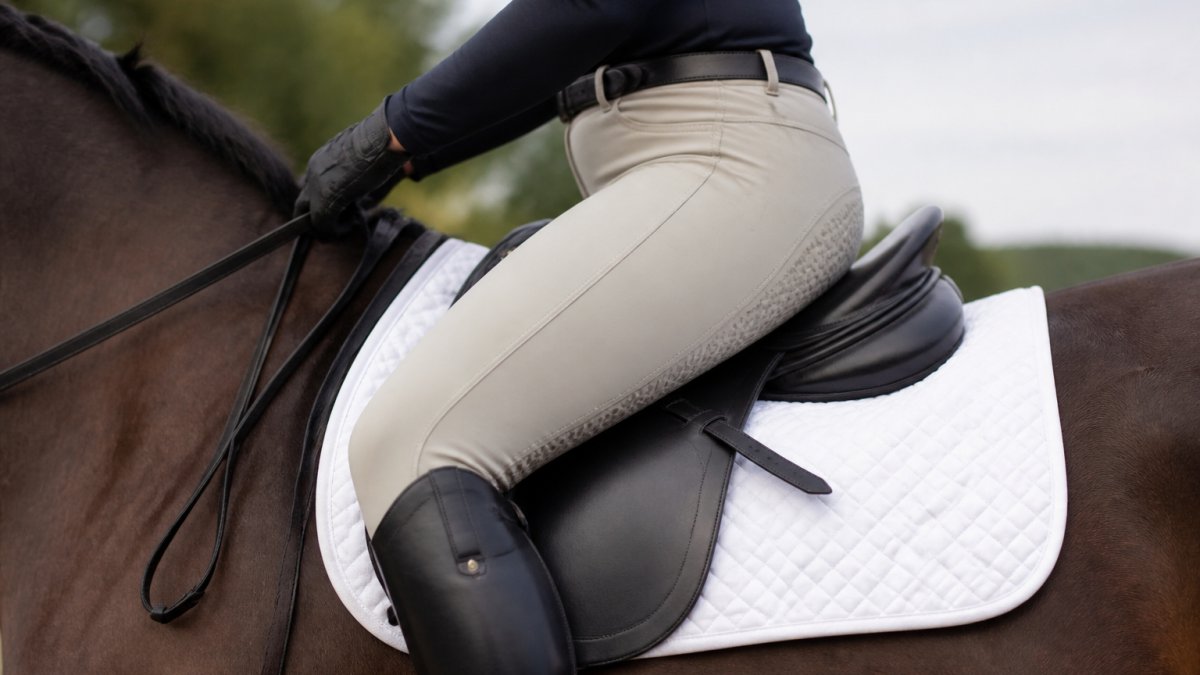
Knee-patch breeches concentrate grip only at the knee and upper calf, leaving the thigh and seat smooth. They suit trail riding and casual barn work because they restrict less and breathe better in warm weather.
Map the grip style to the riding situation
Rather than picking a grip style in the abstract, match it to what you actually do in the saddle. Many riders who school several times a week keep one full-seat pair for lessons and flatwork and one knee-patch pair for hacking and barn days.
- Lessons and flatwork: Full-seat grip helps you hold a quiet lower leg while learning to follow the horse's motion, reducing the temptation to grip with the calf, a common beginner fault.
- Jumping and gridwork: Full-seat grip keeps the leg stable over fences and related distances, where a slipping leg changes your balance point. Many jumping riders prefer a moderate silicone print rather than an aggressive one, so the leg can still slide forward over a fence.
- Trail riding and long hacks: Knee-patch breeches reduce restriction at the hip and thigh over hours in the saddle, and less grip means less fabric pulling against the saddle when you post or stand in your stirrups.
- Competition: Check the rules for your discipline and level before buying. Some show formats favor a specific look, and a full-seat silicone print may be more visible than a suede knee patch. When in doubt, confirm with your trainer or the show's prize list.
- Barn chores and groundwork: Knee-patch or a lighter full seat is usually more comfortable for walking, lifting, and mucking, where maximum saddle grip is not the priority.
How grip material and placement change the feel
Grip is not one thing. Silicone prints vary from fine dots to bold geometric patterns, and coverage changes how much your leg can move. A dense full-seat silicone print gives the most hold but can feel sticky when adjusting your leg. Suede patches offer a softer, more traditional feel; some riders prefer deerskin or leather for a broken-in feel.
Placement matters as much as material. A knee patch that sits too low won't contact the saddle where you need it; a full seat extending too far up the back restricts hip movement. When trying on breeches, sit in a chair and simulate posting and two-point to see where the grip meets the surface.
A quick decision rule
If you are a beginner, ride in a structured lesson program, or jump regularly, start with a full seat. If your riding is mostly trail, hacking, or mixed barn work, a knee patch is often more comfortable and versatile. Experienced riders with an independent seat can choose based on the day's work rather than committing to one style.
Fabric Weight, Stretch, and Breathability: What Matters
Fabric weight determines durability, warmth, and how the breeches move with your body. Lightweight fabrics breathe well for warm weather. Mid-weight fabrics balance durability for daily schooling with warmth for mild weather. Heavy-weight fabrics offer maximum durability and warmth but can feel restrictive in summer.
Stretch is critical for comfort and freedom of movement. Look for stretch content so the breeches move with your body without pulling or binding.
Breathability depends on composition and weave. Cotton blends breathe well; synthetic blends wick moisture and dry faster. Fleece-lined tights add winter warmth. Match fabric to climate: lightweight synthetics for summer, mid-weight blends for spring and fall, fleece-lined for winter.
Best Riding Tights for Beginners: Structure and Support
Riding tights offer beginners a structured entry point into equestrian apparel because they provide consistent grip coverage and a forgiving fit. Full-length grip coverage means your entire leg contacts the saddle, helping beginners develop consistent leg position without overthinking foot placement.
The FitsT4 Sports Women's Full Seat Riding Tights ($134.99) deliver the structure and support beginners need. These tights feature active silicone grip across the full seat and inner leg, providing stability through transitions and helping you maintain a secure lower leg. The stretch fabric moves with your body without restricting your hip or knee, and the waistband sits comfortably without rolling or digging in.
FitsT4 Sports Women's Full Seat Riding Tights →
When selecting tights for beginners, prioritize full-seat grip over knee-patch. Look for reinforced stitching at stress points (waistband, crotch, knee). A mid-weight fabric that breathes but holds its shape will last through repeated washes.
Riding Tights for Summer: Staying Cool in the Saddle
Summer riding demands lightweight fabrics that wick moisture and prevent chafing. Warm-weather riding tights use thinner materials that allow air circulation while maintaining grip coverage. Look for moisture-wicking synthetic blends rather than cotton. Silicone or suede grip works in summer, but avoid fleece-lined options entirely.
Breathability features matter as much as fabric weight. Mesh panels at the inner thigh or back of the knee improve airflow and reduce sweat buildup, while seamless or flat-lock seams prevent chafing on long rides.
For summer schooling, choose lighter colors when possible: black absorbs heat, while gray, tan, or navy reflect more light. Pair summer tights with a lightweight shirt and breathable half chaps or tall boots. Hydration and frequent breaks matter as much as gear.
Durability, Care, and Real-World Value
How you wash and store your riding breeches and tights affects how long they last, and how long they last determines what they cost per ride. Most quality riding apparel should survive with proper care, but grip coating, elastic, and seams fail first. Treat those three areas as the wear indicators.
Wash and care that protects grip and stretch
Turn tights and breeches inside out before washing to protect the grip coating and reduce fading. Use cold water and a gentle cycle; hot water breaks down elastic and weakens seams. Avoid fabric softener and dryer sheets. Close zippers and hook-and-loop closures so they don't snag fabric. Air dry whenever possible; if you must tumble dry, use the lowest heat and remove the garment while slightly damp.
For silicone grip, a soft brush and mild soap remove saddle residue without abrading the print. For suede or leather patches, brush with a suede brush and avoid soaking. Store clean, dry tights and breeches on hangers or folded flat in a cool, dry space; never leave them in a damp gym bag or car trunk, which promotes mildew and odor.
Know when to replace
Inspect your breeches and tights regularly at the stress points: the crotch seam, waistband, and inner thigh where grip coating experiences the most friction. Replace or repair when you see:
- Grip print worn smooth or peeling in the seat or knee
- Waistband elastic stretched so the pants slide down during posting
- Seams fraying at the crotch or inner thigh
- Fabric thinning to the point that it is translucent when stretched
- Persistent odor that survives a proper wash
Small tears or fraying seams should be repaired immediately before they spread. A tailor can often reinforce a crotch gusset or replace a waistband elastic for far less than a new pair.
Cost per wear: the number that actually matters
Budget tights often lose stretch or grip within a season, while mid-range and premium pairs hold their shape for years. Do the math on cost per wear rather than sticker price. If you ride three times a week, that's roughly 150 rides a year. A $40 pair lasting one season costs about $0.27 per ride; a $120 pair lasting three seasons costs about $0.27 per ride too. The budget pair only wins if it lasts nearly as long, which is uncommon once grip coating is involved.
Use this framework:
- Ride 1-2 times per week: A mid-range pair in the $60-$100 range is usually the sweet spot.
- Ride 3-5 times per week: Spend in the $100-$180 range and prioritize replaceable or reinforced grip and a sturdy waistband.
- Ride daily or professionally: Premium pairs in the $150-$250 range with durable silicone or suede and reinforced seams usually deliver the lowest cost per wear.
These ranges reflect typical U.S. retail pricing for women's and men's riding tights and breeches; sales and closeouts can move them significantly. The point is the comparison: divide price by the number of rides you expect before the grip or elastic fails, and compare that figure across options.
Value signals to look for before you buy
- Reinforced crotch gusset and flat-lock seams at high-stress points
- Grip material described as silicone or suede rather than a generic coating
- A waistband with a defined elastic or drawcord rather than a thin sewn channel
- Care instructions that acknowledge the grip surface
- A return or warranty policy that lets you test fit before committing
At Horsey Horse Store, we focus on gear that delivers real durability for everyday riders who need equipment that performs consistently.
Frequently Asked Questions
What is the main difference between riding breeches and riding tights?
Riding breeches are structured pants that typically end at the ankle or calf with a tailored fit, often featuring reinforced grip panels and belt loops. Riding tights are form-fitting leggings that extend the full length of the leg with a second-skin feel and compression throughout. Breeches offer a more polished appearance and structured support, while tights provide greater freedom of movement and a closer connection with the saddle.
Are riding tights suitable for beginners?
Yes, riding tights are excellent for beginners. The compression and stretch fabric provide support without restriction, and the full-leg grip helps beginners feel more secure in the saddle. Many new riders prefer the comfort and confidence that tights offer during early lessons. However, some beginners choose breeches for their structured fit and polished look, so it ultimately depends on personal preference and what your instructor recommends.
Can you wear riding tights in warm weather?
Yes, lightweight riding tights designed for warm weather are available in breathable fabrics that wick moisture and allow airflow. Look for tights made from thinner stretch materials without fleece lining. Many riders choose summer-weight tights over heavier options to stay cool while maintaining the grip and support they need during rides. Pairing them with a light-colored or moisture-wicking base layer can further improve comfort on hot days.
Which option provides better grip in the saddle: breeches or tights?
Both can provide excellent grip when designed properly. Breeches typically feature silicone or full-seat grip panels in specific areas like the seat and inner thigh, while riding tights often have compression and stretch fabric throughout that creates consistent contact. Full-seat breeches offer the most grip coverage, while knee-patch breeches focus grip on the lower leg. Tights provide continuous grip along the entire leg, which many riders find gives them a closer feel with the horse.