

Table of Contents
- Why Saddle Pads Shrink During Washing
- Water Temperature and Its Impact on Fiber Integrity
- Choosing the Best Detergent for Horse Saddle Pads
- How to Dry Saddle Pads Without Shrinking
- Machine Washing vs. Hand Washing for Shrinkage Prevention
- Protecting Different Materials: Wool, Felt, and Synthetic Fibers
- Fixing Shrinkage: What to Do If Your Saddle Pad Has Already Shrunk
Last Updated: August 24, 2026
Why Saddle Pads Shrink During Washing
Saddle pad shrinkage is one of the most frustrating issues riders face after washing. Understanding what causes it is the first step to preventing it from happening to your gear. When natural fibers like wool and felt absorb water during washing, the fibers swell and can lock into a smaller shape as they dry (peer-reviewed research). This process, called felting, happens when agitation, heat, and moisture combine in ways that permanently alter the fiber structure.

Synthetic fibers shrink differently. They respond to heat more than agitation. A high dryer temperature or even hot water can cause permanent shrinkage in polyester and nylon blends. The key difference is that synthetic shrinkage often happens faster and is harder to reverse. Natural fibers give you more warning signs during the washing process itself.
The real culprit behind most saddle pad shrinkage is rushing the drying process. Riders often throw wet pads into the dryer on high heat to speed things up before the next ride. That decision can cost you the lifespan of an expensive pad. Even moderate heat applied too quickly can cause the fibers to contract unevenly, creating permanent size loss. The damage happens in minutes, but preventing it takes planning.
Water Temperature and Its Impact on Fiber Integrity
The temperature of your wash water is the single most important variable you control when cleaning a saddle pad. Cold water is your safest choice for nearly all saddle pad materials. Cold water minimizes the risk of fiber swelling and prevents the heat-triggered shrinkage that affects synthetic materials.

Warm water sits in a dangerous middle ground. It's not hot enough to kill most bacteria, but it's warm enough to start opening up fiber structures. Many riders use warm water thinking it cleans better, but the trade-off isn't worth it. The pad might look cleaner, but you're increasing shrinkage risk with every degree above cold.
Hot water should be avoided entirely for saddle pads unless the care label specifically permits it for sanitizing purposes. Even then, the risk outweighs the benefit for most home washing situations. Hot water causes rapid fiber expansion, especially in wool and felt pads. When those fibers cool and dry, they contract into a permanently smaller configuration.
The pH-neutral soap you choose matters as much as temperature. Acidic or alkaline detergents can weaken fiber bonds, making shrinkage worse. When you combine the wrong detergent with warm water, you're essentially pre-shrinking your pad before it even gets wet. This is why detergent selection deserves its own careful attention.
The Textile Care Labeling Rule from the FTC provides guidelines on how manufacturers must communicate fiber content and care instructions. Understanding these labels helps you interpret what your specific pad needs.
Choosing the Best Detergent for Horse Saddle Pads
Not all detergents are created equal when it comes to saddle pads. Standard laundry detergents contain surfactants and enzymes designed to break down oils and proteins. Those same ingredients can damage the delicate fibers in your pad, especially wool and felt. A pH-neutral soap is non-negotiable if you want to preserve your pad's integrity.
Specialized saddle pad cleaners exist for exactly this reason. The 5 Star Equine Saddle Pad Cleaner & Soak at Horsey Horse Store is formulated specifically for horse tack. It works on wool, synthetic fibers, and even leather without the harsh chemicals that cause shrinkage or discoloration. This product costs $42.99 and handles multiple wash cycles, making it a practical investment compared to replacing a damaged pad.
When choosing any detergent, look for products labeled "gentle" or "delicate." Avoid anything with bleach, optical brighteners, or heavy enzymes. These additives break down fiber bonds and make shrinkage more likely. The detergent should dissolve completely in cold water without leaving residue, since detergent buildup can trap moisture and cause uneven drying.
Many riders make the mistake of using more detergent thinking it cleans better. Extra detergent leaves residue that traps water in the fibers. That trapped moisture prolongs drying time and increases the chance of uneven shrinkage. Use the minimum amount recommended on the label, or even slightly less if your pad isn't heavily soiled.
How to Dry Saddle Pads Without Shrinking
Air drying is the only method that reliably prevents saddle pad shrinkage. This is where patience becomes your best tool. Lay the wet pad flat on a clean towel or drying rack in a well-ventilated area away from direct sunlight. The flat position ensures even moisture distribution as the pad dries. Uneven drying creates uneven shrinkage, so positioning matters.

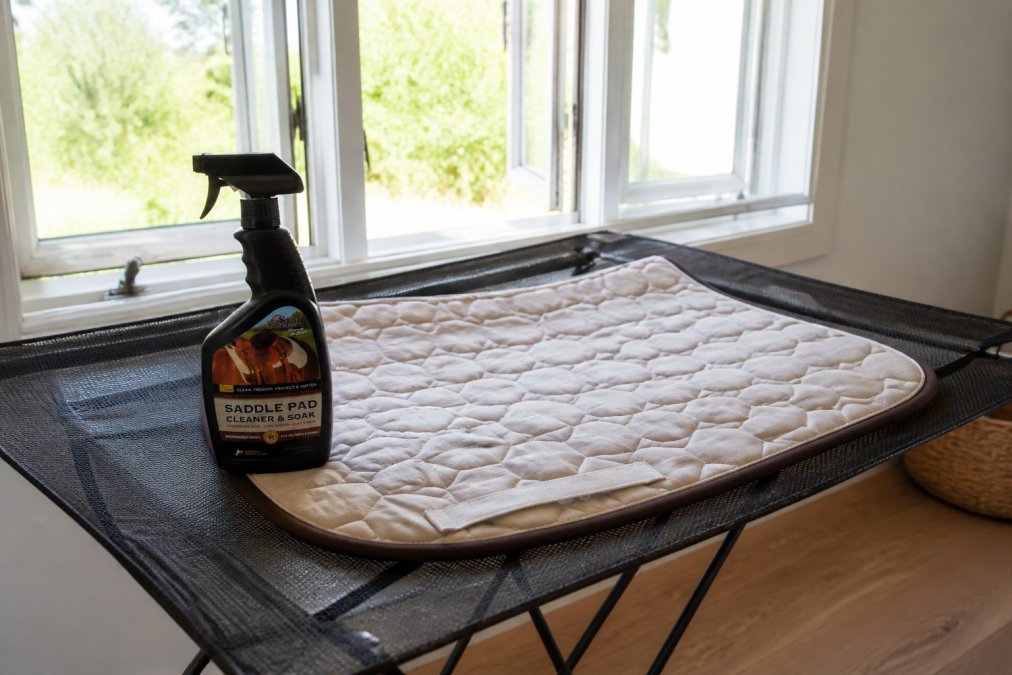
Avoid hanging your pad to dry, even though it seems efficient. Hanging concentrates the weight of the water in the lower portion of the pad, creating stress on the fibers. That stress combined with uneven moisture evaporation leads to distortion and shrinkage. Flat drying distributes the weight evenly across the entire surface.
Direct sunlight can fade colors and damage some synthetic fibers, so choose a shaded, well-ventilated spot. A basement, laundry room, or covered porch works well. Air circulation is critical. A fan positioned nearby (not directly on the pad) speeds drying without creating hot spots. The goal is slow, even moisture evaporation, not rapid drying.
Drying time depends on humidity and air movement. Most saddle pads take 24 to 48 hours to dry completely when laid flat in good conditions. Resist the urge to speed this up with heat. The extra time spent waiting is worth the protection of your pad. Once completely dry, you can fold and store it without worry.
Machine Washing vs. Hand Washing for Shrinkage Prevention
Hand washing gives you the most control over every variable that affects shrinkage. You control water temperature, agitation level, rinse cycles, and drying method. This control makes hand washing the safest choice for expensive or delicate pads. The tradeoff is time and effort, but the protection justifies it for pads you want to keep for years.
A gentle cycle on a washing machine can work if you follow specific precautions. Use cold water only, select the gentlest cycle available, and skip the spin cycle if possible. The spin cycle applies intense centrifugal force that can cause uneven shrinkage. If your machine doesn't have an option to skip spinning, remove the pad before that phase starts.
Hand washing process: fill a basin with cold water and add a small amount of pH-neutral soap. Submerge the pad and gently agitate the water around it for a few minutes. Avoid wringing or twisting. Drain and rinse with fresh cold water multiple times until no soap residue remains. Excess detergent is one of the hidden causes of shrinkage, so thorough rinsing is essential.
The real advantage of hand washing isn't just control, it's visibility. You can inspect the pad during washing for any signs of damage, loose seams, or areas that need extra attention. Machine washing hides these problems until it's too late. For pads with reinforced seams or pressure points, hand washing lets you be gentler with vulnerable areas.
Machine Washing vs. Hand Washing for Shrinkage Prevention
Hand washing gives you the most control over every variable that affects shrinkage. You control water temperature, agitation level, rinse cycles, and drying method. This control makes hand washing the safest choice for expensive or delicate pads. The tradeoff is time and effort, but the protection justifies it for pads you want to keep for years.
A gentle cycle on a washing machine can work if you follow specific precautions. Use cold water only, select the gentlest cycle available, and skip the spin cycle if possible. The spin cycle applies intense centrifugal force that can cause uneven shrinkage. If your machine doesn't have an option to skip spinning, remove the pad before that phase starts.
Hand washing process: fill a basin with cold water and add a small amount of pH-neutral soap. Submerge the pad and gently agitate the water around it for a few minutes. Avoid wringing or twisting. Drain and rinse with fresh cold water multiple times until no soap residue remains. Excess detergent is one of the hidden causes of shrinkage, so thorough rinsing is essential.
The real advantage of hand washing isn't just control, it's visibility. You can inspect the pad during washing for any signs of damage, loose seams, or areas that need extra attention. Machine washing hides these problems until it's too late. For pads with reinforced seams or pressure points, hand washing lets you be gentler with vulnerable areas.
Protecting Different Materials: Wool, Felt, and Synthetic Fibers
Different materials require different protection strategies because they shrink through different mechanisms. Wool and felt respond to moisture and agitation. Synthetic fibers respond to heat. Understanding your pad's primary material is the foundation of a shrinkage prevention plan.
Wool saddle pads are luxurious and absorbent, but they're also the most shrinkage-prone. Wool fibers have microscopic scales that lock together when exposed to heat, moisture, and agitation simultaneously. This is the felting process, and it's permanent. To protect wool pads, use cold water exclusively, minimize agitation, and never use a dryer. Wool pads need 48 to 72 hours of flat air drying to fully dry.
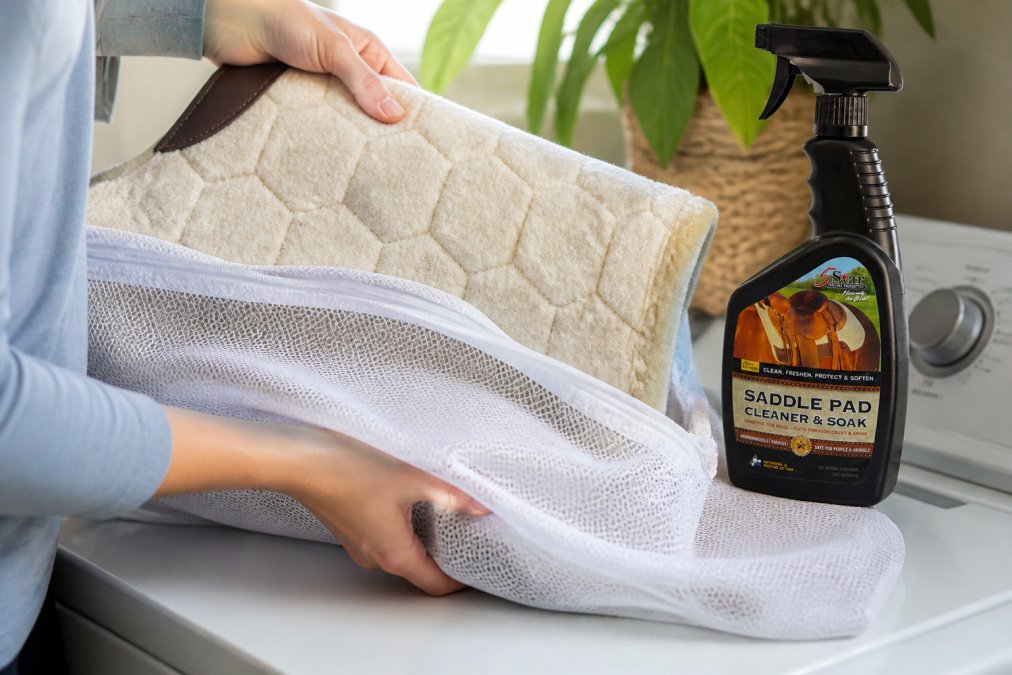
Felt pads are compressed wool, so they follow similar rules as pure wool but with slightly more tolerance for gentle handling. Felt is already felted, so additional felting is less likely, but shrinkage still occurs from heat exposure. The key with felt is avoiding any temperature increase during washing and drying. A mesh wash bag provides extra protection during machine washing by reducing direct agitation on the pad's surface.
Synthetic fiber pads (polyester, nylon blends) are more heat-sensitive than moisture-sensitive. These pads can handle cold machine washing better than wool, but they absolutely cannot tolerate heat. Never put a synthetic pad in a dryer, even on low heat. Air drying is mandatory. Synthetic pads typically dry faster than wool (24 to 36 hours) because the fibers don't absorb as much water.
Using a protective wash bag is one of the simplest shrinkage prevention tools available. A mesh bag lets water and soap flow through while reducing the direct tumbling that causes uneven shrinkage. This is especially valuable if you're using a machine wash cycle. The bag acts as a buffer between the pad and the machine's agitation.
Fixing Shrinkage: What to Do If Your Saddle Pad Has Already Shrunk
If your saddle pad has already shrunk, some options exist depending on how severe the damage is. Minor shrinkage (less than half an inch) might not affect fit or function. Check your pad against your saddle to see if it still sits correctly. If the fit is still acceptable, you can continue using it and focus on preventing further shrinkage.
Moderate shrinkage requires intervention. Some riders attempt to stretch the pad back to its original size by soaking it in cool water and gently pulling it to shape while drying. This works occasionally with wool pads but rarely with felt or synthetics. The process takes patience: soak the pad in cool water for 30 minutes, gently stretch it to approximate the original dimensions, and lay it flat to dry. This method succeeds occasionally, so don't expect miracles.
Severe shrinkage (more than an inch in any dimension) usually means the pad is no longer usable. A pad that no longer fits your saddle creates pressure points and reduces performance. At this point, replacement is more practical than repair attempts. This is where quality saddle pads from Horsey Horse Store make sense as an investment. The Harrison Howard Dressage Saddle Pad ($79.99) and HORZE Adepto Quilted All-Purpose Saddle Pad ($42.99) are both designed to resist shrinkage when cared for properly.
The LeMieux Dressage Carbon Mesh Square Saddle Pad ($164.99) represents a higher investment but includes advanced materials that resist shrinkage better than basic pads. Premium pads often use treated fibers or blended materials that have been pre-shrunk during manufacturing. Paying more upfront for a quality pad means fewer replacement cycles and less frustration.
Prevention is always cheaper than replacement. Every time you wash a saddle pad, you're either protecting your investment or damaging it. The difference comes down to cold water, gentle handling, pH-neutral soap, and air drying. Those four practices prevent nearly all shrinkage issues.
The American Textile Manufacturers Institute provides fiber care standards that align with how most quality saddle pads should be treated. Understanding these standards helps you evaluate any pad's care requirements.
Frequently Asked Questions
Q: Does hot water cause saddle pads to shrink?
A: Yes, hot water is one of the primary causes of saddle pad shrinkage. Heat causes fibers to contract, especially in natural materials like wool and felt. Cold water (below 60°F) or lukewarm water (60-80°F) is much safer. Always check the manufacturer's care tag, but cold water is the default choice for preventing saddle pad shrinkage. If your pad has visible dirt or horse sweat buildup, pre-soaking in cold water with a pH-neutral soap works just as well as hot water without the shrinkage risk.
Q: Can I put my saddle pad in the washing machine?
A: Many saddle pads can go in a washing machine on a gentle or delicate cycle with cold water, but hand washing is safer for preventing shrinkage. If you use a machine, use a mesh wash bag to reduce agitation, select cold water, and skip the spin cycle or use the lowest setting. Synthetic fibers tolerate machine washing better than wool or felt. Always check your pad's care label first. Hand washing gives you complete control over water temperature, detergent residue removal, and agitation, making it the preferred method for protecting fiber integrity.
Q: What is the best way to wash saddle pads to avoid shrinkage?
A: Hand wash in cold water using a pH-neutral soap or specialized saddle pad cleaner like the 5 Star Equine Saddle Pad Cleaner & Soak ($42.99). Fill a basin with cold water, dissolve the detergent, submerge the pad, and gently agitate for 5-10 minutes. Focus on pressure points and areas with horse sweat buildup. Rinse thoroughly in multiple cold-water rinses until all detergent residue is gone, leftover soap can stiffen the pad and weaken fibers. Never wring or twist; instead, gently squeeze water out. Air dry flat or draped over a rack in a well-ventilated area away from direct heat or sunlight.
Q: How often should I wash my saddle pad?
A: Wash your saddle pad every 2-4 weeks with regular use, or after every 3-5 rides if you school frequently. More frequent washing is needed if your horse sweats heavily or you ride in dusty conditions. Spot-clean visible dirt and horse sweat between full washes using a damp cloth. Regular maintenance washes with cold water and gentle detergent are easier on the pad's fibers than allowing sweat and dirt to accumulate, which can damage material density and cause stiffening. Always use cold water and minimal agitation to preserve the pad's shape and prevent shrinkage over time.
Saddle pad shrinkage doesn't have to be inevitable. By understanding what causes it and taking deliberate steps to prevent it, you protect your equipment and your budget. Horsey Horse Store carries saddle pads from trusted brands and the specialized cleaner you need to keep them in shape. Start with the 5 Star Equine Saddle Pad Cleaner & Soak, follow the cold water and air-drying protocols outlined here, and your pads will stay in service for years instead of months.
This article was written using GrandRanker