

Table of Contents
- What Makes a Wheelbarrow Right for Horse Barn Work
- Best Wheelbarrow for Mucking Stalls: Capacity and Design
- One Wheel vs Two Wheel Wheelbarrow: Which Handles Barn Floors Better
- Heavy-Duty Wheelbarrow with Flat-Free Tire: Tire Performance and Durability
- Plastic vs Metal Wheelbarrow: Materials for Manure and Moisture
- Construction-Grade Steel and Frame Strength: What Lasts in Barn Conditions
- Common Mistakes to Avoid When Choosing a Barn Wheelbarrow
- Frequently Asked Questions
Last Updated: October 19, 2026
What Makes a Wheelbarrow Right for Horse Barn Work
Heavy-duty wheelbarrows horse barns are built for constant mucking, hauling manure, and moving bedding across uneven terrain. Unlike general-purpose yard wheelbarrows, it must withstand moisture, corrosive materials, and daily heavy use.
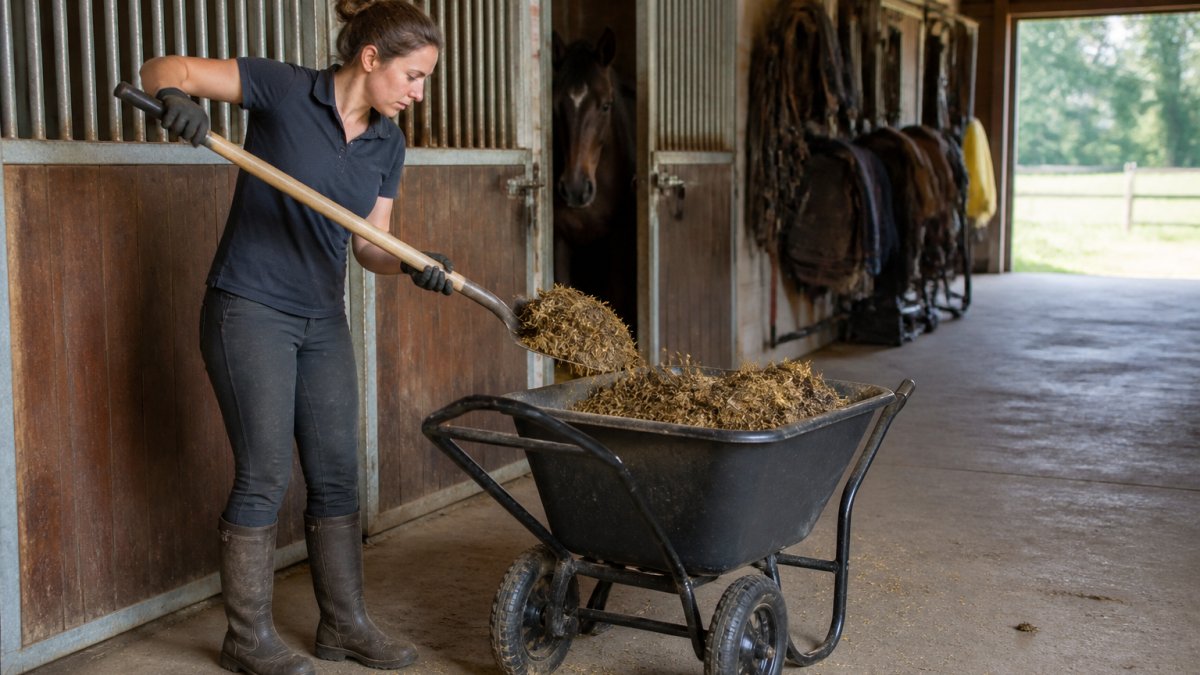
The right wheelbarrow makes stall cleaning faster and reduces strain. A poorly chosen one tips easily, rusts quickly, or collapses under load. At Horsey Horse Store, we know barn managers need equipment that performs day after day.
Four factors separate a good barn wheelbarrow from a mediocre one: capacity matched to your workflow, corrosion-resistant materials, wheel design suited to barn floors, and frame strength for repeated heavy loads. Most general wheelbarrows fail on at least two.
Best Wheelbarrow for Mucking Stalls: Capacity and Design
Advertised tub volume is a poor guide on its own. A wheelbarrow rated at 6 cubic feet rarely holds 6 cubic feet of soiled bedding, because manure and wet shavings pack and mound above the rim. The useful number is how many stalls one heaped load clears before you dump.
Size a barn wheelbarrow by working backward from your routine. A typical 12-foot-by-12-foot stall with a few inches of bedding produces roughly one-third to one-half of a wheelbarrow load per cleaning when you strip only wet spots and manure.
Bedding type shifts those numbers. Light shavings and pelleted bedding produce less volume per stall, so a mid-size tub goes further. Straw and heavy sawdust produce more volume and weight, pushing you toward a larger tub only if you can still push it full.
Weight limits matter equally. Most heavy-duty steel wheelbarrows are rated for 300 to 600 pounds, plastic tubs for 200 to 400. Wet manure and soaked shavings can push a heaped 6-cubic-foot load toward the top of that range.
Tub shape changes how much capacity you actually use. A sloped tub that tapers toward the wheel dumps cleanly without scraping. A flat-bottomed tub holds more but needs more tipping effort and leaves residue to hose or scrape.
Choose a tub of durable plastic or coated steel. Plastic resists rust and manure acids but can crack in cold or under sharp impact. Metal is heavier but more puncture-resistant and lasts longer in rough conditions.
One Wheel vs Two Wheel Wheelbarrow: Which Handles Barn Floors Better
The right wheel configuration depends less on preference than on the surfaces you cross.
A two-wheel wheelbarrow, or yard cart, trades maneuverability for stability and capacity.
Barn floors are not one surface. Rubber stall mats have seams that catch a small wheel; a 14- to 16-inch tire rolls over them far more easily than a 10-inch tire.
Ramps and thresholds are another barn-specific condition. A loaded single-wheel barrow on a barn-to-trailer ramp is tippy and demands a firm grip.
For most horse barns with flat aisles and standard stall doors, a single-wheel wheelbarrow wins on maneuverability. Many barn managers compromise with a single-wheel barrow and wide flat-free tire for indoor mucking plus a two-wheel cart for outdoor hauling.
The wheel itself matters as much as the count. A pneumatic tire gives the smoothest ride and absorbs shock, but it can puncture and needs inflation. A flat-free tire eliminates punctures and maintenance but transmits more vibration.
Ergonomics matter too. Handle height should let you push with your legs and a straight back rather than bending at the waist; handles set too low will be felt in your lower back by the end of a mucking session.
Repairability is the last piece most buyers overlook. Tires, bearings, and handles wear out first, so check that replacements are available and that axle and handle bolts are standard sizes you can source locally.
Never overload a wheelbarrow beyond its rated capacity, even with a flat-free tire. Overloading stresses the frame, wheel bearings, and handles. A cracked frame or bent axle can't be safely repaired and often means replacing the entire wheelbarrow.
Heavy-Duty Wheelbarrow with Flat-Free Tire: Tire Performance and Durability
A heavy-duty wheelbarrow with flat-free tire design eliminates a common frustration: a punctured tire that strands you mid-cleaning. Flat-free tires use solid foam or polyurethane instead of air, making them impervious to nails, thorns, or sharp manure-pile debris.
The tradeoff is comfort. Flat-free tires transmit more vibration through the frame into your hands and arms, especially on concrete, which can increase fatigue over long sessions. For most barn managers, never dealing with a puncture outweighs the slight discomfort.
Tire size affects performance and load capacity. A larger diameter tire (typically 13 to 16 inches) rolls more easily over obstacles and uneven ground. A smaller tire (10 to 12 inches) is lighter but harder to push through mud or gravel. For barn work, a 14 to 16-inch flat-free tire balances roll-over ability and weight.
Tread pattern influences traction. A deeper tread grips better on wet or muddy surfaces, which matters through exterior mud or wet manure piles. A shallower tread works fine on dry barn flooring and concrete but can slip when wet.
Plastic vs Metal Wheelbarrow: Materials for Manure and Moisture
Plastic wheelbarrows have become popular for barn use, and for good reason. Plastic resists rust and corrosion from manure acids and moisture, two constant threats in horse barns. They're also lighter and easier to push when empty or partially loaded, and a quick hose rinse removes residue without rust worries.
The downside is durability in extreme conditions. Plastic can crack when struck in freezing temperatures, and years of UV exposure make it brittle. Plastic tubs also have lower weight capacity than comparable steel models, typically maxing out around 6 cubic feet before structural concerns arise.
Metal wheelbarrows, usually powder-coated steel, offer superior strength and longevity and handle impact and overloading better than plastic. But steel requires maintenance: chips in the powder coating expose bare metal to rust in the moist, corrosive barn environment, and a rusted wheelbarrow weakens structurally and eventually fails.
For horse barn use, plastic wins for low-maintenance durability: lighter weight reduces strain, and corrosion resistance means no seasonal rust fighting. If you'll maintain a steel wheelbarrow by touching up chips and storing it under cover, steel offers a longer ultimate lifespan and higher capacity.
A middle ground exists: steel tubs with heavy-duty plastic or rubber liners. The liner protects the steel from corrosion while the frame provides strength. These cost more upfront but can significantly extend service life.
Construction-Grade Steel and Frame Strength: What Lasts in Barn Conditions
Frame construction determines whether a wheelbarrow survives years of daily barn use or fails within a season or two. A construction-grade frame uses thicker-gauge steel (typically 14 to 16 gauge) welded at stress points. Look for continuous welds along tub-to-frame joints, not spot welds or rivets, which fail under repeated stress.
Handle attachment is critical. Bolted handles are more durable than welded ones because you can replace a broken handle without replacing the whole wheelbarrow. Handles should be reinforced at the connection point with gussets or brackets to prevent bending or cracking under load.
Wheel bearings deserve attention too. Ball bearings, sealed or open, last longer than simple axle holes. Sealed ball bearings require less maintenance and handle the repetitive rotation of daily use better than a simple bolt-through axle.
Frame geometry also affects durability. A low center of gravity, with the tub positioned lower relative to the wheel, is more stable and puts less stress on the frame during tipping. A high center of gravity increases tipping risk and stresses structural joints.
Powder coating on steel frames matters. A thick, even coat (typically 2 to 3 mils) protects better than thin paint. Inspect for evenness before purchase; thin spots indicate rushed manufacturing and a shorter lifespan.
Common Mistakes to Avoid When Choosing a Barn Wheelbarrow
The first mistake is buying on price alone. A budget wheelbarrow might cost half as much as a construction-grade model, but it will fail within one or two seasons of daily barn use. Replacing it multiple times ultimately costs more than investing in quality upfront.
The second mistake is oversizing capacity. A 10-cubic-foot wheelbarrow sounds appealing until you're pushing 100+ pounds of wet manure and bedding. Most people then leave it half-full, which defeats the purpose. Buy capacity you can actually manage when full.
The third mistake is ignoring wheel and tire choice. Pneumatic tires puncture at the worst moments. Flat-free tires require no maintenance but transmit vibration. Neither is objectively wrong, but choosing without understanding the tradeoff leads to frustration.
A fourth mistake is overlooking frame durability for tub features. A beautiful plastic tub on a weak frame will fail when you need it most. Prioritize frame strength and wheel bearings; the tub is secondary.
Finally, many barn managers don't account for storage and maintenance. A wheelbarrow stored outside in wet conditions deteriorates faster than one kept under cover. If you can't store it dry, choose plastic over steel. If you can maintain it, steel offers better long-term value.
Choosing the right heavy-duty wheelbarrows horse barns comes down to matching capacity to your workflow, selecting corrosion-resistant materials, and prioritizing frame strength over aesthetic features. Our selection of practical barn accessories, from wheelbarrows to grooming supplies, is designed to simplify your daily routine and keep your operation running smoothly.
Frequently Asked Questions
What size wheelbarrow is best for mucking out a horse stall?
A heavy-duty wheelbarrow for mucking stalls should hold 6-8 cubic feet of capacity, enough to clear one stall's bedding and manure in one or two loads without requiring constant trips. Smaller wheelbarrows (4-5 cu-ft) work for light yard tasks but slow down barn routines. Larger models (10+ cu-ft) are harder to maneuver in tight barn aisles and doorways. Match capacity to your stall size and how often you clean; daily mucking benefits from the 6-8 cu-ft sweet spot.
Is a one-wheel or two-wheel wheelbarrow better for barn chores?
A single-wheel wheelbarrow offers superior maneuverability in tight barn spaces, doorways, and around obstacles, making it ideal for stall cleaning. Two-wheel and four-wheel carts provide more stability on uneven ground and are better for hauling heavy loads over long distances. For daily stall mucking, a single-wheel design wins; for hauling gravel, feed, or bedding delivery across rough terrain, a two-wheel or cart-style option reduces tipping risk and fatigue.
Are pneumatic or flat-free tires better for a barn wheelbarrow?
Flat-free (solid) tires are superior for horse barns because they resist punctures from manure, bedding fragments, and rough barn floors, eliminating mid-task repairs. Pneumatic (air-filled) tires offer a smoother ride and less arm strain but require maintenance and can go flat when exposed to sharp objects common in barn environments. For heavy-duty barn work, flat-free tires reduce downtime and frustration, making them the practical choice despite slightly more effort to push.
What should I look for in a heavy-duty wheelbarrow for durability in barn conditions?
Choose a wheelbarrow with a powder-coated steel frame to resist rust from moisture and manure washdown, and a plastic or galvanized steel tub that won't corrode. Check that welds are reinforced and the frame handles at least 300 lbs load capacity. Verify the wheel hub is sealed to keep moisture out, and confirm replacement parts (tires, handles, tubs) are available. Heavy-duty construction-grade materials and easy repairability ensure your investment lasts through years of daily barn use.