

Last Updated: October 22, 2026
Quick Summary
Common causes of horse back soreness from saddles include poorly fitted saddles that concentrate pressure unevenly, bridging panels that create two pressure points instead of distributing weight evenly, muscle strain from constant pressure against the saddle, and girth issues that shift the saddle or cause compensatory bracing.
- A saddle that bridges contacts only the front and back panels while gapping in the middle, creating two damaging pressure points.
- Most saddle-related muscle soreness improves with 2-4 weeks of rest combined with corrected saddle fit.
- You should fit at least two fingers comfortably under the front of the saddle at the withers to ensure proper clearance.
- Unbalanced rider position and poor training technique can create saddle soreness even with a well-fitted saddle.
- Check saddle fit every 4-6 weeks during active riding season as your horse's fitness and muscle development change.
Table of Contents
- Why Saddle Fit Matters for Your Horse's Back
- Signs of Saddle Soreness in Horses
- How Poorly Fitted Saddles Cause Back Pain
- How to Check Saddle Fit on a Horse
- Distinguishing Saddle-Related Soreness From Other Causes
- Treating Back Soreness in Horses
- Preventing Back Pain in Horses
- Frequently Asked Questions
Why Saddle Fit Matters for Your Horse's Back
A poorly fitted saddle is one of the most common causes of horse back soreness from saddles, yet many riders don't realize how critical proper fit truly is.
The spine, withers, and surrounding muscle groups bear the weight of both saddle and rider.
Understanding how saddle fit directly causes back pain helps you identify problems early. The good news: many saddle-related soreness issues can be prevented or corrected before they become serious.
Signs of Saddle Soreness in Horses
Behavioral and Physical Indicators
Your horse will communicate discomfort through behavior long before serious injury develops. Watch for these specific signs that point to saddle-related soreness rather than other causes.
Behavioral changes often appear first:
- Resistance to saddling, flinching when you touch the back
- Bucking, rearing, or refusing to move forward under saddle
- Tail clamping or wringing during or after riding
Physical indicators you can observe:
- Swelling or heat along the back, especially under saddle contact points
- Hair loss or white marks on the back from pressure
- Muscle atrophy (wasting) along the topline or loin area
Performance Changes to Watch For
Performance problems are often the first sign a rider notices. A horse that previously moved freely may suddenly:
- Refuse jumps or lose enthusiasm for work
- Move with shortened stride or stiffness
- Show reluctance to engage the hindquarters
These changes warrant immediate investigation. Don't assume your horse is being stubborn or lazy. Pain changes behavior, and back discomfort directly affects how a horse moves and performs.
How Poorly Fitted Saddles Cause Back Pain
Pressure Points and Saddle Panels
The saddle tree and panels create contact points along your horse's back. When fit is poor, these points concentrate pressure instead of distributing it. The withers, spine, and loin are especially vulnerable to pressure damage.
Common pressure zones from poor saddle fit:
- Directly on the spine (saddle lacks proper clearance)
- At the withers (saddle too narrow or sits too far back)
- Behind the saddle (tree angle doesn't match horse's back)
A saddle that bridges, meaning it contacts only the front and back of the panels while gapping in the middle, creates two pressure points and leaves the center unsupported. This is one of the most damaging fit problems. The horse's back is forced to fill the gap, and the concentrated pressure at the contact points causes inflammation and muscle damage.
Muscle Strain and Soft-Tissue Damage
Constant pressure and movement against a poorly fitted saddle creates micro-tears in muscle fibers. Over time, these small injuries accumulate into significant soft-tissue damage. The muscles along the back, especially those supporting the thoracolumbar region and loin, are most affected.
Muscle strain from saddle pressure causes:
- Inflammation and swelling in affected areas
- Muscle spasm as the body tries to protect the injured tissue
- Compensatory muscle tension in other areas
Once muscle damage occurs, your horse needs rest and proper treatment to recover. Continuing to ride with the same saddle during recovery prevents healing and deepens the injury.
Girth Issues and Compensatory Bracing
The girth plays a critical role in saddle stability and pressure distribution. A girth that's too tight, too loose, or positioned incorrectly creates its own problems and compounds saddle fit issues.
An ill-fitting girth:
- Shifts the saddle during riding, changing pressure points constantly
- Pinches the horse's sides, causing pain separate from back soreness
- Forces the horse to brace muscles to stabilize the saddle
When a horse braces to compensate for an unstable saddle or girth, it tightens muscles along the back and sides. A quality girth like the SIE EQUESTRIAN Contoured Chafeless English Girth helps maintain stable contact.

How to Check Saddle Fit on a Horse
Step-by-Step Fit Assessment
You don't need professional equipment to perform a basic saddle fit check.
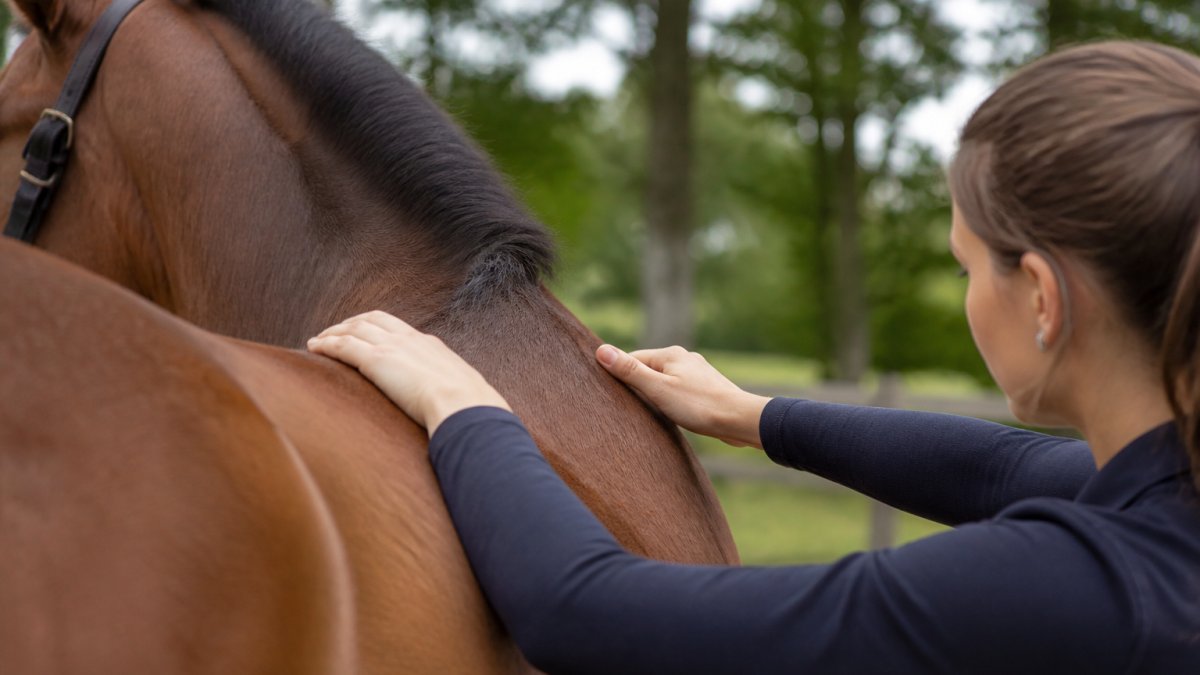
Step 1: Assess saddle clearance over the spine
Place the saddle on your horse's back without a pad.
Step 2: Check withers clearance
Slide your fingers under the front of the saddle at the withers.
Step 3: Evaluate panel contact
Place the saddle on a clean back (no sweat or dirt).
Step 4: Test saddle balance
Place the saddle on the horse's back without fastening anything.
Step 5: Check tree angle against horse's conformation
Stand to the side and look at the angle of the saddle tree (the front and back edges).
Harrison Howard Dressage Saddle Pad →
Documenting Fit Changes with Workload
Saddle fit changes as your horse's fitness and muscle development change. A saddle that fits well in spring may not fit properly by fall after months of conditioning.
Create a simple fit record:
- Take photos of the saddle on your horse from the side, front, and back
- Note the sweat pattern after riding
- Record any behavioral changes or performance shifts
When you notice changes, more pressure marks in one area, new behavioral resistance, or performance decline, compare current photos to previous ones. This documentation shows whether the problem is saddle fit or something else.
Distinguishing Saddle-Related Soreness From Other Causes
Conformation, Arthritis, and Medical Conditions
Back soreness can stem from many sources beyond saddle fit. Distinguishing saddle-related pain from other causes determines your treatment approach.
Conformation issues create permanent structural challenges but don't necessarily mean saddle soreness:
- Horses with long backs or weak loins are predisposed to back problems
- Poor conformation makes finding proper saddle fit harder but doesn't cause soreness by itself
- A well-fitted saddle can minimize conformation-related stress
Arthritis and spinal abnormalities cause soreness independent of saddle fit:
- Arthritis in the spine causes stiffness and reduced range of motion
- Kissing spines (where vertebrae touch abnormally) cause chronic pain (Impinging and Overriding Spinous Processes in Horses: A Narrative Review)
- These conditions require veterinary diagnosis and management
Gastric ulcers cause back sensitivity that mimics saddle soreness:
- Horses with ulcers often resist saddling and show back sensitivity
- The soreness pattern doesn't match saddle pressure points
- A veterinarian can diagnose ulcers through gastroscopy
How to distinguish saddle soreness from other causes:
- Saddle soreness typically appears in pressure zones under the saddle
- Other causes usually create generalized back sensitivity or stiffness
- Saddle soreness often improves quickly when fit is corrected
Rider Balance and Training Technique
A rider's position and balance directly affect how the saddle sits and distributes pressure. Poor rider technique can create saddle soreness even with a well-fitted saddle.
Unbalanced riders create uneven pressure:
- A rider who sits to one side shifts the saddle and creates asymmetrical pressure
- Riders who perch forward or sit too far back change saddle balance
- Tension in the rider's body transfers to the horse and causes compensatory bracing
Training mistakes compound saddle fit problems:
- Asking for collection before the horse's back muscles are strong enough causes strain
- Working a young or unfit horse too hard creates muscle damage
- Inconsistent or harsh riding creates tension and bracing
Evaluating rider position and technique is part of solving back soreness. Sometimes the saddle fit is acceptable, but the rider's position or training approach is causing the problem.
Treating Back Soreness in Horses
When to Call Your Veterinarian
Some saddle soreness responds to rest and saddle adjustment. Other cases require professional evaluation and treatment. Know when to call your veterinarian.
Call your veterinarian if:
- Soreness doesn't improve after correcting saddle fit and resting for 2-3 weeks
- Your horse shows lameness, severe swelling, or heat in the back
- Behavioral changes are severe or worsening
A veterinarian can perform palpation, assess range of motion, and recommend imaging (ultrasound or radiographs) if needed. Early professional evaluation prevents minor soreness from becoming chronic damage.
Rest is the foundation of recovery:
- Most saddle-related muscle soreness improves with 2-4 weeks of rest
- Light hand-walking or turnout is acceptable during recovery
- Avoid riding until soreness resolves and fit is corrected
Preventing Back Pain in Horses
Saddle Pads, Girth Selection, and Tack Setup
Quality saddle pads provide cushioning and help distribute pressure more evenly. However, pads cannot fix a poorly fitted saddle. They can only reduce the damage a bad saddle causes.
Saddle pad selection matters:
- Thick pads don't fix poor saddle fit; they only mask pressure problems temporarily
- Quality pads like the Harrison Howard Dyna-Sorb Half Saddle Pad provide shock absorption
- Sheepskin or wool pads like the Woolous Dressage Sheepskin Saddle Pad offer natural breathability
Girth selection prevents pressure problems:


- A well-designed girth stays in place and maintains stable saddle position
- Contoured girths follow the horse's body shape and reduce pinching
- Proper girth tightness prevents shifting that creates new pressure zones
Tack setup prevents compensatory problems:
- Ensure all equipment fits your horse's body, not just your saddle
- A bridle that's too tight or a noseband that pinches creates tension
- Boots or wraps that are too snug restrict movement and cause bracing
Regular Maintenance and Fit Checks
Prevention requires ongoing attention. Build fit checks into your regular horse care routine.
Monthly fit assessment:
- Perform the step-by-step fit check outlined earlier
- Take photos to track changes over time
- Note any behavioral or performance shifts
Seasonal adjustments:
- Check fit when your horse's weight or muscle changes
- Reassess after extended time off
- Evaluate fit when changing workload or discipline
Professional help:
- Have a qualified saddle fitter evaluate your setup annually
- Professional fitters can identify subtle problems you might miss
- A good fitter helps you understand your horse's specific needs
Regular maintenance and fit checks catch problems early, when they're easiest and cheapest to fix. Prevention is far more effective than treating soreness after it develops.
Frequently Asked Questions
How can I tell if my saddle is causing my horse back soreness?
Look for behavioral changes like resistance to saddling, reduced performance, or gait asymmetry during or after rides. Palpate your horse's back along the withers and spine for muscle spasms, sensitivity, or swelling. Check saddle fit by ensuring the saddle clears the spine, sits level, and distributes pressure evenly across the saddle panels. If soreness appears only during ridden work and improves with rest, saddle fit is likely the culprit. Consult a veterinarian to rule out underlying medical conditions like arthritis or conformation issues.
What are the most common signs of saddle soreness in horses?
Common signs include muscle atrophy along the back, behavioral resistance to saddling, reduced range of motion, gait changes, or lameness. Your horse may exhibit compensatory bracing, show sensitivity to palpation, or display reluctance to move forward. Some horses develop muscle spasms or show visible swelling. Performance may decline, or your horse may refuse jumps or resist certain gaits. These signs often appear within days of a poorly fitted saddle and improve when saddle fit is corrected.
How often should I check my horse's saddle fit?
Check saddle fit every 2-4 weeks during regular riding, and whenever your horse's condition changes. Horses gain or lose weight seasonally, and their muscle development shifts with workload, both affecting fit. After a break from work, recheck fit before returning to regular riding. If you notice behavioral changes, gait asymmetry, or reduced performance, assess fit immediately. Documenting fit changes helps you spot problems early and distinguish saddle-related soreness from other causes.
Can a saddle pad fix an ill-fitting saddle?
A quality saddle pad can improve comfort and provide shock absorption, but it cannot correct fundamental fit problems. Padding may mask minor pressure points temporarily, but it cannot resolve issues with saddle tree width, balance, or panel clearance. Using extra padding on a poorly fitted saddle can actually worsen fit by shifting the saddle or creating new pressure points. The Harrison Howard Dyna-Sorb Half Saddle Pad ($79.99) and Woolous Dressage Sheepskin Saddle Pad ($238.99) enhance comfort for well-fitted saddles.
Back soreness from saddles is preventable. Most cases stem from fit problems you can identify and correct before they cause lasting damage. Start with a thorough fit assessment, invest in quality equipment like saddle pads from Horsey Horse Store, and commit to regular checks as your horse's fitness changes. When you catch fit problems early and address them promptly, your horse stays comfortable and performs at his best. A comfortable horse is a happy horse, and that's what matters most.
