

Table of Contents
- Quick Comparison: Best Saddle Pads for Trail Riding
- Saddle Pad Thickness Guide for Long Trail Rides
- Signs of a Poorly Fitting Saddle Pad
- Top Trail Riding Saddle Pads Reviewed
- How to Clean a Western Saddle Pad (and Keep It Trail-Ready)
- How We Evaluated These Trail Riding Saddle Pads
- Conclusion: Which Saddle Pad Is Right for Your Trail Riding?
- Frequently Asked Questions
Last Updated: September 12, 2026
Quick Comparison: Best Saddle Pads for Trail Riding
The best saddle pads for trail riding balance shock absorption, moisture management, and spine clearance over hours in the saddle. This guide breaks down thickness, fit, materials, and maintenance. Pressure points unnoticed in a 30-minute schooling session become sores after four hours on uneven ground.
Quick Picks:
- Best for Spine Relief: Reinsman Contoured Trail Pad ($209.99), contoured design with a spine relief channel
- Best Value: CHALLENGER Quilted Endurance Saddle Pad ($112.99), contoured shape at a mid-range price
- Best Shock Absorption: Harrison Howard Dyna-Sorb Half Pad ($76.99), memory foam layer for impact protection
- Best for Bareback Riders: CHALLENGER Bareback Trail Saddle Pad ($222.99), built specifically for bareback trail work
- Best Western Style: Tahoe Tack Hand-Woven Navajo Saddle Blanket ($89.99), traditional look with practical function
| Pad | Price | Best For | Key Feature |
|---|---|---|---|
| Reinsman Contoured Trail Pad | $209.99 | Spine relief | Spine relief channel |
| CHALLENGER Quilted Endurance | $112.99 | Overall value | Contoured endurance cut |
| Harrison Howard Dyna-Sorb | $76.99 | Shock absorption | Memory foam half pad |
| CHALLENGER Bareback Trail Pad | $222.99 | Bareback riders | Bareback-specific build |
| Tahoe Tack Navajo Blanket | $89.99 | Western style | Hand-woven acrylic |
Saddle Pad Thickness Guide for Long Trail Rides
Most trail riders need a pad between 1/2 inch and 1 inch thick. Thinner pads suit well-fitting saddles; thicker pads compensate for minor fit gaps or add cushioning for long hours. Thickness depends on your saddle type, your horse's back shape, and how the pad compresses under load.

A common mistake is assuming thicker always means better. A pad that is too thick lifts the saddle off the horse's back, concentrates girth pressure, and creates the exact pressure points you were trying to prevent. The American Association of Equine Practitioners guidance on saddle fit notes that saddle fit directly affects back health, and pad thickness is part of that equation.
Thickness Ranges by Use Case
- Under 1/2 inch: Close contact for well-fitted saddles, minimal cushioning
- 1/2 to 3/4 inch: The everyday range for most trail saddles
- 3/4 to 1 inch: Extra cushioning for long trail rides or older horses
- Over 1 inch: Only when compensating for a saddle that needs refitting
Saddle-Type Compatibility Matrix
The right pad thickness and shape depend on what saddle sits on top of it. Use this matrix as a starting point, then verify with a hands-on fit check.
| Saddle Type | Typical Pad Thickness | Shape That Works Best | What to Watch For |
|---|---|---|---|
| Western trail | 3/4 to 1 inch | Square or contoured, 30" x 30" to 32" x 32" | Bar spread and skirt length; a pad shorter than the skirt bunches at the edges |
| Endurance | 1/2 to 3/4 inch | Contoured with wither cutout | Weight distribution over long distance; avoid bulk that shifts at a trot |
| Treeless | 1/2 to 3/4 inch, firm | Contoured with defined spine channel | Treeless saddles transmit pressure directly, so the pad must distribute load, not just cushion |
| English/close-contact | 1/2 inch or less | Shaped or square | Too much thickness lifts the rider and changes leg position |
| Bareback | 1/2 to 1 inch, soft | Bareback-specific cut | Rider comfort and grip; standard pads slide without a tree to anchor them |
How Thickness Interacts With Gullet Clearance
Gullet clearance is the space between the pommel arch and the horse's withers, and adding pad thickness reduces it. A pad that seems harmless on the rack can press on the withers once the saddle is girthed and the rider's weight settles in. To check: with the saddle and pad girthed, slide your fingers under the pommel. You want roughly two fingers of clearance. Less means go thinner; much more means a slightly thicker pad can improve contact and stability.
Compression: Why Nominal Thickness Misleads
A pad labeled 1 inch does not stay 1 inch under a rider. Dense felt may compress 20 to 30 percent under load; open-cell foam compresses more; closed-cell foam and gel hold thickness better but weigh more and breathe less (PubMed). A 1-inch felt pad and a 1-inch gel pad do not deliver the same clearance or cushioning.
Press pads between your hands, a pad that bottoms out under hand pressure will bottom out under a rider. For long trail rides, a pad that holds roughly 70 to 80 percent of its loft under load balances cushioning with stability.
Matching Thickness to Your Horse's Back
- High withers, narrow back: Thinner contoured pad with a defined wither cutout; extra thickness here causes pressure, not relief.
- Mutton withers, round back: Slightly thicker pad plus a non-slip bottom; the risk is slippage, not pressure.
- Older horse with a swayed back: Thicker pad (3/4 to 1 inch) to fill the dip and distribute weight, paired with a saddle that already fits.
- Young or changing horse: Start thinner and reassess every few months as muscling develops.
Signs of a Poorly Fitting Saddle Pad
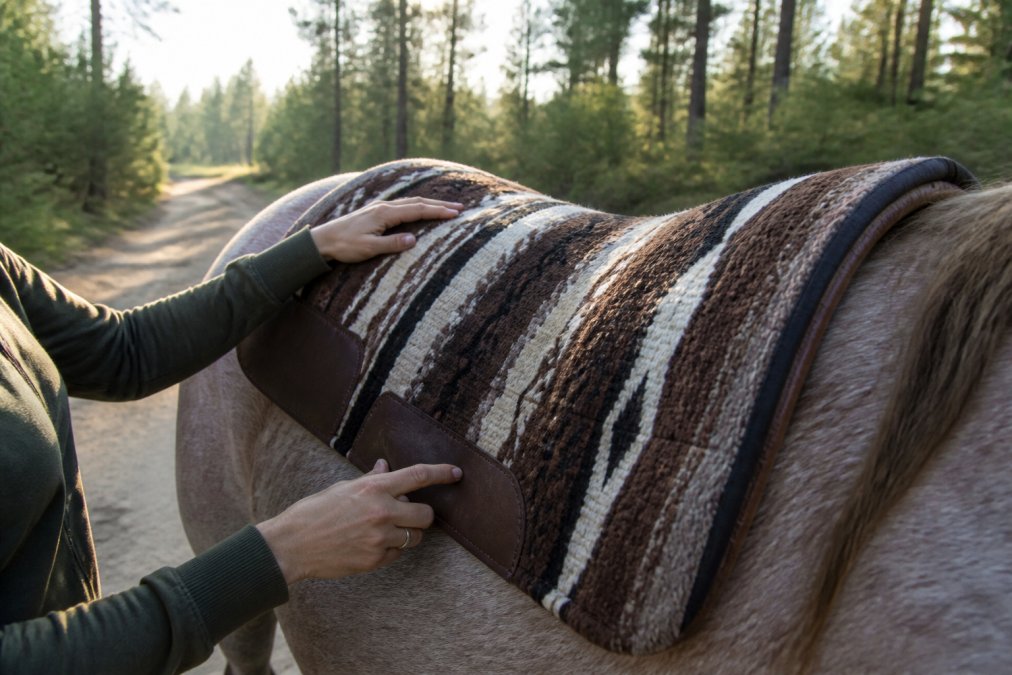
A poorly fitting saddle pad shows up as dry spots, rubbed hair, or sore pressure points after a ride. Check your horse's back within 30 minutes of unsaddling, while sweat marks are still visible.

Watch for these signals:
- Dry patches under the saddle: Indicate pressure points where circulation is cut off
- White or rubbed hair: Friction from a pad that shifts or bunches
- Sore spots along the spine: Often from a pad without spine clearance
- Pad slipping sideways: Poor shape match or worn non-slip backing
- Heat buildup: A pad that traps moisture instead of wicking it
If you see any of these, the pad is not doing its job. Get a saddle fit assessment before blaming the pad alone.
Top Trail Riding Saddle Pads Reviewed
Every pad below is reviewed based on pressure distribution, moisture handling, and durability.
Reinsman Contoured Trail Pad: Best for Spine Relief
The Reinsman Contoured Trail Pad is the top pick for horses that need spine clearance on long rides. Its contoured design follows the back's shape and the spine relief channel keeps pressure off the vertebrae. The Tacky Too bottom grips the horse's back, reducing slippage on steep terrain, and the 30-inch by 34-inch dimensions suit most western trail saddles.
Specs: 30" L x 34" D, Diablo Red, breathable non-slip bottom Price: $209.99 Best for: Horses with prominent withers or a history of back soreness
Pros:
- Spine relief channel reduces pressure points
- Tacky Too bottom limits slippage
- Breathable and shock absorbing
Cons:
- Highest price in this review
- Contoured cut may not suit every square-skirt saddle
CHALLENGER Quilted Endurance Saddle Pad: Best Value
For riders who want a contoured endurance pad without the top-tier price, the CHALLENGER Quilted Endurance Saddle Pad delivers. The barrel and endurance cut gives freedom of movement, the contoured shape supports weight distribution, and quilted construction helps with breathability. At $112.99, it covers the essentials: contoured fit, moisture wicking, and durable stitching.
Specs: Black, western quilted endurance cut Price: $112.99 Best for: Riders logging long trail rides who want contoured support without the premium
Pros:
- Contoured endurance shape
- Quilted for breathability
- Mid-range price
Cons:
- No spine relief channel
- Limited color options
Harrison Howard Dyna-Sorb Half Pad: Best Shock Absorption
The Harrison Howard Dyna-Sorb Half Pad targets shock absorption directly. Its memory foam layer compresses under impact and returns to shape, which helps on hard-packed trails and rocky ground. Half pads sit between the saddle and your regular pad, so this is a smart add-on if your current pad fits well but your horse still shows signs of impact soreness.
Specs: Aegean Blue with white print, full shock-absorbing memory half pad Price: $76.99 Best for: Adding shock protection to an existing pad setup
Pros:
- Memory foam absorbs impact
- Layers over an existing pad
- Affordable upgrade
Cons:
- Not a standalone pad
- Adds bulk under a close-contact saddle
CHALLENGER Bareback Trail Saddle Pad: Best for Bareback Riders
Bareback riders need a different pad entirely, and the CHALLENGER Bareback Trail Saddle Pad is built for it. At 36 inches long and 26 inches wide, it covers the seat area without excess material. The deluxe build includes pockets for small items on the trail, and the turquoise color stands out for visibility.
Specs: 36" L x 26" W, Turquoise, with pockets Price: $222.99 Best for: Riders who ride bareback or with minimal tack
Pros:
- Designed specifically for bareback riding
- Built-in pockets
- Comfortable padding for the rider
Cons:
- Premium price
- Not compatible with a standard saddle
Tahoe Tack Hand-Woven Navajo Saddle Blanket: Best Western Style
Riders who want traditional western style without sacrificing function should look at the Tahoe Tack Hand-Woven Navajo Saddle Blanket. The hand-woven acrylic construction gives the classic Navajo pattern in turquoise, black, and white. At 32 by 64 inches, it works as a blanket layer under a pad or on its own for lighter riding, and acrylic resists shrinking better than wool when washed.
Specs: 32" x 64", Turquoise/Black/White, hand-woven acrylic Price: $89.99 Best for: Western riders who want traditional style with easy care
Pros:
- Hand-woven traditional pattern
- Acrylic resists shrinking
- Multiple color options
Cons:
- Less shock absorption than foam-backed pads
- Needs a pad underneath for long rides
How to Clean a Western Saddle Pad (and Keep It Trail-Ready)
Cleaning a western saddle pad depends on its material, but the routine is simple: remove hair and sweat after every ride, deep clean every few weeks, and dry completely before storage.

Follow these steps:
- Brush off dried sweat, hair, and dirt with a stiff brush after each ride
- For synthetic pads, machine wash cold on a gentle cycle with mild detergent
- For wool or felt, hand wash in cool water and avoid agitation that causes felting
- Skip fabric softener, which clogs wicking fibers
- Air dry flat, away from direct heat, until fully dry before storing
- Check stitching and non-slip backing for wear every month
How We Evaluated These Trail Riding Saddle Pads
Each pad can be judged on five criteria that determine real trail performance: pressure distribution, moisture wicking, shock absorption, fit and shape, and durability. Here is how they can be weighted, and how you can run the same math on any pad.
The Five Criteria and How They Were Weighted
- Pressure distribution (30%): Contoured designs, spine clearance, and even weight distribution under the bars. A pad that concentrates weight fails on long rides no matter how it looks.
- Moisture wicking and breathability (20%): Quilted construction and breathable backing score higher. A pad that traps heat softens skin and sets up rubs.
- Shock absorption (20%): Memory foam and dense felt layers absorb impact; thin quilted pads do not.
- Fit and shape (15%): Does the pad match the saddle type and the horse's back? A great pad in the wrong shape is a bad pad.
- Durability (15%): Stitched edges, quality materials, and how many seasons a pad survives before the backing delaminates or the quilting breaks down.
Cost-Per-Ride: The Math Most Reviews Skip
Price tags tell you what you pay today; cost per ride tells you what the pad costs over its life. The formula is simple:
Cost per ride = Purchase price ÷ (Rides per week × Weeks per season × Seasons of service)
Here is how that plays out across the price range, assuming a rider who logs three rides per week over a 30-week season:
| Pad | Price | Assumed Service Life | Rides per Season | Cost per Ride |
|---|---|---|---|---|
| Harrison Howard Dyna-Sorb Half Pad | $76.99 | 2 seasons | 90 | $0.43 |
| Tahoe Tack Navajo Blanket | $89.99 | 3 seasons | 90 | $0.33 |
| CHALLENGER Quilted Endurance | $112.99 | 3 seasons | 90 | $0.42 |
| Reinsman Contoured Trail Pad | $209.99 | 5 seasons | 90 | $0.47 |
| CHALLENGER Bareback Trail Pad | $222.99 | 4 seasons | 90 | $0.62 |
Service life is an estimate based on construction and materials, not a warranty. A well-built pad costing twice as much can cost less per ride if it lasts two to three times as long. A $210 pad that survives five seasons beats a $90 pad that fails in one.
Long-Term Back Health: What the Materials Actually Do
Shock absorption matters most on the rides you do not notice. A pad that lets impact through causes problems over hundreds of rides, as repeated pressure and vibration contribute to muscle soreness, dry spots, and in some cases localized atrophy along the back (aaep.org). Material choice drives this:
- Wool and felt: Dense, breathable, and good at spreading load. They compress over time and need replacing when they lose loft.
- Memory foam: Excellent at absorbing peak impact, but it traps heat and can break down faster than felt under heavy use.
- Gel: Holds thickness and absorbs vibration well, but it is heavy and does not breathe, which can cause heat buildup on long summer rides.
- Fleece: Soft and good for preventing friction, but it offers little shock absorption on its own and is best used as a liner.
The practical rule: match the material to the ride. For hot trail days, prioritize breathability and load spreading; for rocky, hard-packed ground, impact absorption; for horses with back soreness, spine clearance and even pressure over cushioning thickness.
How to Run This Evaluation Yourself
- Check gullet clearance with the saddle and pad girthed.
- Ride for at least an hour, then check for dry spots, rubbed hair, and heat under the pad within 30 minutes of unsaddling.
- Note how the pad compresses after the ride, if it stays flat, it has bottomed out.
- Track how many seasons it lasts before the backing or quilting fails.
- Divide the price by total rides to get your true cost per ride.
Conclusion: Which Saddle Pad Is Right for Your Trail Riding?
Match the pad to your horse's back and your saddle, not to the price tag. For most trail riders, the Reinsman Contoured Trail Pad offers the best combination of spine relief, non-slip grip, and durability. Budget-conscious riders get solid contoured support from the CHALLENGER Quilted Endurance pad, while bareback riders should go straight to the CHALLENGER Bareback Trail Pad.
A pad is only as good as the fit underneath it. Horsey Horse Store carries practical trail gear with free shipping over $25, 30-day returns on clean, unused items, and secure checkout. Add to cart and get your setup trail-ready.
Frequently Asked Questions
What thickness saddle pad is best for trail riding?
For most trail riding, a pad between 1/2 and 3/4 inch thick works well. Thinner pads (1/4 inch) suit close-contact saddles with a good fit, while thicker pads (1 inch or more) help with pressure distribution on long rides. The right choice depends on your saddle fit and horse's back shape. A saddle pad thickness guide can help you decide based on your specific setup and ride duration.
Are wool felt saddle pads better than synthetic for trail riding?
Wool felt pads offer excellent moisture wicking and heat dissipation, which keeps your horse's back cooler on long trail rides. They also mold to the back over time for a custom fit. Synthetic pads are lighter, easier to clean, and often more affordable. For endurance riding or long trail rides, wool felt is often preferred, but synthetic options like the CHALLENGER Quilted Endurance Saddle Pad provide good breathability and shock absorption at a lower price.
How do I know if my saddle pad is the right size for my horse?
A properly sized saddle pad extends about 1 to 2 inches beyond the saddle skirt on all sides. It should not bunch up under the saddle or extend so far that it creates pressure points. Check that the pad clears the withers and doesn't interfere with the saddle's fit. Signs of a poorly fitting saddle pad include dry spots, rubbing, or saddle slippage during rides.
Do I need a contoured saddle pad for trail riding?
Contoured saddle pads are designed with a spine clearance channel and an anatomical shape that follows your horse's back. They reduce pressure on the spine and withers, which is especially important on long trail rides. If your horse has a prominent wither or you ride for hours, a contoured design like the Reinsman Contoured Trail Pad can improve comfort and prevent soreness. Flat pads work for shorter rides or horses with well-muscled backs.
How often should I replace my horse's saddle pad?
Replace your saddle pad when you notice compressed padding, worn-out non-slip backing, or persistent dirt and odor that cleaning can't fix. For daily trail riding, a quality pad may last 1 to 2 years with proper care. Signs it's time for a new one include uneven pressure marks on your horse's back, saddle slippage, or visible thinning in high-contact areas. Regular cleaning extends the life of any pad.
Finding the right pad is a process of matching thickness, shape, and material to your horse's back and your saddle. Horsey Horse Store makes that process simpler with a curated tack selection, free shipping over $25, 30-day returns on clean, unused items, and secure checkout. Get started with Horsey Horse Store and build a trail setup that keeps your horse comfortable mile after mile.